
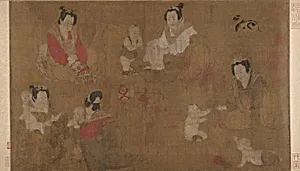
宋 佚名 倣周昉 戲嬰圖 卷|Palace Ladies Bathing Children
11th century
Medium
Handscroll; ink and color on silk
Dimensions
Image: 12 × 19 1/8 in. (30.5 × 48.6 cm) Overall with mounting: 12 7/16 × 44 in. (31.6 × 111.8 cm)
Classification
Paintings
Culture & Period
China · Song dynasty (960–1279)
Department
Asian Art
Museum
Metropolitan Museum of Art, New York, NY
Credit
Fletcher Fund, 1940
Accession Number
40.148
Rights
Public Domain
Tags
Art Historical Context
This delightful handscroll, titled *Palace Ladies Bathing Children (戲嬰圖), is a Song dynasty (960–127) work from the 11th century, by an unidentified artist emulating the Tang master Zhou Fang (active ca. 785–810). Zhou Fang was renowned for his elegant depictions of courtly women, characterized by their full-figured forms and graceful poise, a style that influenced generations. During the Song era, artists frequently copied Tang masters to preserve and revive classical ideals amid a golden age of Chinese painting. Executed in ink and color on silk—a luxurious medium prized for its luminous sheen and ability to capture subtle textures—the handscroll unfolds sequentially, inviting viewers to follow the tender scene of palace ladies playfully bathing and tending infants. The intimate domestic moment contrasts with imperial splendor, highlighting everyday joys in elite life. Such works reflect Song connoisseurship, where handscrolls served as portable treasures for scholars and collectors. Housed in the Metropolitan Museum of Art's Asian Art department (acquired via the Fletcher Fund in 1940), this piece exemplifies how Song painters bridged Tang realism with their own refined lyricism, offering a window into China's cultural reverence for harmony, family, and artistic tradition.
About the Artist
Zhou Fang|Unidentified artist ( |Chinese) · |0780 – |0810
|Chinese, active ca. 780– ca.810