
Lakdoos met binnenbak en deksel
1300 - 1500
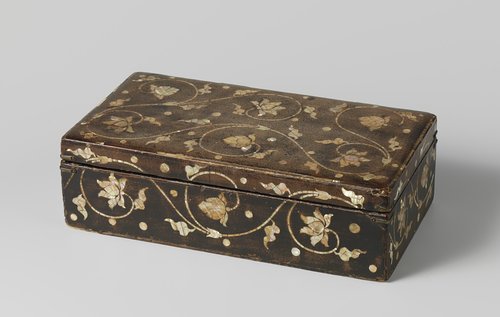
Medium
lacquer (coating)
Dimensions
34.5; 10.5; 19.5
Rights
Public Domain
About this artwork
…; from Prof. Dr Ernst Grosse (1862-1927), Freiburg, M 6,000, together with AK-MAK-141 and AK-MAK-164 to Herman Karel Westendorp (1868-1941), Amsterdam, August 1929;{Note RMA.} his widow Betsy Westendorp-Osieck (1880-1968), Amsterdam, by whom bequeathed to the Vereniging van Vrienden der Aziatische Kunst, 1968;{note RMA.} from whom on loan to the museum, 1972
Art Historical Context
This exquisite lacquer box, titled *Lakdoos met binnenbak en deksel* (Lacquer Box with Inner Tray and Lid), dates to the 14th or 15th century (1300–1500) and exemplifies the anonymous mastery of East Asian lacquerware traditions. Measuring a compact 10.5 cm high, 34.5 cm wide, and 19.5 cm deep, its rectangular form with an inner tray and fitted lid suggests practical use for storing valuables, cosmetics, or documents, transformed into a work of refined artistry through layered lacquer coating—a technique derived from the sap of the lacquer tree, applied in thin coats, polished to a glossy sheen, and often inlaid or painted for decoration. Lacquerware reached artistic heights during this era, particularly in China and Japan, where it symbolized luxury and technical virtuosity. The medium's durability and luminous finish made such boxes prized possessions among elites, blending functionality with aesthetic elegance. Though details of its surface design are not specified, the object's survival highlights lacquer's remarkable preservation qualities over centuries. Its provenance traces a fascinating path through European collectors: acquired by German scholar Prof. Dr. Ernst Grosse (1862–1927), it passed to Amsterdam collector Herman Karel Westendorp in 1929, then to his widow Betsy Westendorp-Osieck, who bequeathed it to the Vereniging van Vrienden der Aziatische Kunst in 1968. On loan to the museum since 1972, it reflects early 20th-century enthusiasm for Asian arts in the West.
About the Artist
anonymous
In the vast tapestry of art history, "Anonymous" stands not as a singular individual but as a collective designation for countless unidentified creators whose works have endured across millennia. These artists, spanning prehistoric cave painters to medieval illuminators and folk craftsmen, produced the foundational layers of human visual culture. Prior to the Renaissance, when individual fame emer...