
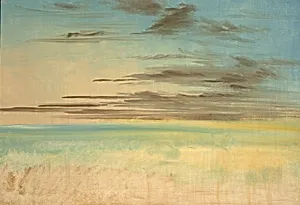
Landscape Background
1846-1848
Medium
Painting
Classification
Painting
Department
Smithsonian Collection
Museum
Smithsonian American Art Museum
Credit
Smithsonian American Art Museum, Gift of Mrs. Joseph Harrison, Jr.
Accession Number
1985.66.580-U
Rights
Public Domain
Tags
About this artwork
“The landscape scenes of these wild and beautiful regions, are, of themselves, a rich reward for the traveler.” (Catlin, Letters and Notes, vol. 2, no. 37, 1841; reprint 1973)
Art Historical Context
George Catlin's *Landscape Background* (184-1848) captures the vast, untamed beauty of the American West, region that captivated the artist during his pioneering expeditions among Native American tribes. Catlin, renowned for his of Indigenous peoples in the 1830s, often painted these expansive landscapes as backdrops to bring authenticity to his subjects. Created during a later phase of his career, this oil painting reflects his deep immersion in the "wild and beautiful regions" of the Great Plains, serving as both an artistic study and a testament to the frontier's allure before widespread settlement. As Catlin himself wrote in his *Letters and Notes* (1841), “The landscape scenes of these wild and beautiful regions, are, of themselves, a rich reward for the traveler.” This quote underscores the painting's Romantic emphasis on nature's grandeur, blending realistic detail with evocative sweep to evoke the sublime power of the Western wilderness. His technique—precise brushwork rendering distant horizons, rolling prairies, and dramatic skies—highlighted the cultural importance of these lands to Native peoples and early explorers. Today, housed in the Smithsonian American Art Museum through the gift of Mrs. Joseph Harrison, Jr., this work invites visitors to ponder the fleeting majesty of America's heartland, preserved through Catlin's visionary gaze.
About the Artist
George Catlin · 1796–1872
George Catlin (1796–1872), born in Wilkes-Barre, Pennsylvania, to Putnam Catlin and Polly Sutton—who had been captured by Native Americans during the 1778 Battle of Wyoming—initially pursued a legal career. Trained at Litchfield Law School, he was admitted to the bar in 1819 but abandoned law after two years to study art in Philadelphia in 1823. Self-taught as a portraitist, Catlin quickly gained ...