
Landscape Background
1846-1848
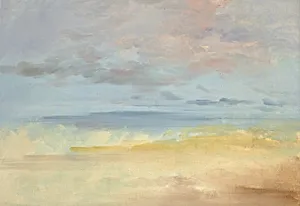
Medium
Painting
Classification
Painting
Department
Smithsonian Collection
Museum
Smithsonian American Art Museum
Credit
Smithsonian American Art Museum, Gift of Mrs. Joseph Harrison, Jr.
Accession Number
1985.66.495-U
Rights
Public Domain
Tags
About this artwork
“The landscape scenes of these wild and beautiful regions, are, of themselves, a rich reward for the traveler.” (Catlin, Letters and Notes, vol. 2, no. 37, 1841; reprint 1973)
Art Historical Context
George Catlin's *Landscape Background* (184–1848) captures the majestic vistas of the American West, region that profoundly inspired the artist during his extensive travels among Native American tribes in the 1830s and 1840s. As a pioneering ethnographer and painter, Catlin documented the "wild and beautiful" landscapes he encountered, often using them as backdrops for his iconic portraits of Indigenous peoples. This oil painting, housed in the Smithsonian American Art Museum, exemplifies his commitment to preserving the untamed frontier before westward expansion altered it forever. Catlin himself eloquently described such scenes in his *Letters and Notes on the Manners, Customs, and Conditions of the North American Indians* (1841): “The landscape scenes of these wild and beautiful regions, are, of themselves, a rich reward for the traveler.” Though painted slightly later, this work reflects that awe, rendered in Catlin's realistic style with meticulous attention to atmospheric light, expansive skies, and rugged terrain—hallmarks of early American landscape art influenced by Romanticism. Acquired as a gift to the Smithsonian, this piece underscores Catlin's enduring legacy in celebrating Western wilderness and Native cultures, inviting visitors to ponder the fleeting beauty he so passionately recorded.
About the Artist
George Catlin · 1796–1872
George Catlin (1796–1872), born in Wilkes-Barre, Pennsylvania, to Putnam Catlin and Polly Sutton—who had been captured by Native Americans during the 1778 Battle of Wyoming—initially pursued a legal career. Trained at Litchfield Law School, he was admitted to the bar in 1819 but abandoned law after two years to study art in Philadelphia in 1823. Self-taught as a portraitist, Catlin quickly gained ...