
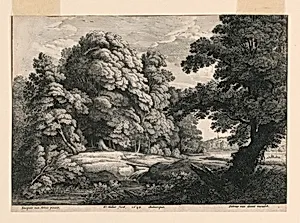
Landscape with a Waterfall
Classification
Department
Smithsonian Collection
Museum
Smithsonian American Art Museum
Credit
Smithsonian American Art Museum
Accession Number
1957-41-140
Rights
Public Domain
About this artwork
Research in Progress
Art Historical Context
Wenceslaus Hollar, a Bohem-born artist (1607–1677) renowned for his exquisite etchings, created *Landscape with a Waterfall in 1648. Fleeing religious wars in his homeland, Hollar settled in England around 163, where he became one of the era's most prolific printmakers, producing over 2,500 works that captured landscapes, city views, and daily life with meticulous detail. This print reflects his topographic style, influenced by the Dutch Golden Age tradition of precise natural observation, during a turbulent time marked by the English Civil War—Hollar himself was briefly exiled to Antwerp around this period. As a print from the Smithsonian American Art Museum's collection, the work exemplifies 17th-century printmaking's revolutionary role in democratizing art. Etchings like Hollar's allowed for multiple impressions, making intricate landscapes accessible beyond elite patrons. Though the exact medium awaits further research, Hollar's technique—fine lines evoking mist, foliage, and cascading water—highlights his mastery in rendering light and texture on a small scale, blending realism with poetic tranquility. Visitors will appreciate this piece for its timeless invitation to pause amid nature's drama, a window into Hollar's wanderlust and enduring legacy in bridging Continental and British art. (198 words)