
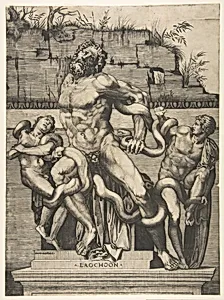
Laocoön and his sons being attacked by serpents
ca. 1515–27
Medium
Engraving, lower right corner made up with ink
Dimensions
Sheet (Trimmed): 17 7/16 × 12 15/16 in. (44.3 × 32.9 cm)
Classification
Prints
Department
Drawings and Prints
Museum
Metropolitan Museum of Art, New York, NY
Credit
The Elisha Whittelsey Collection, The Elisha Whittelsey Fund, 1949
Accession Number
49.97.122
Rights
Public Domain
Tags
Art Historical Context
This striking engraving captures the dramatic torment of Laocoön and his sons as they struggle against coiling serpents, a scene drawn from classical mythology and famously described in Virgil’s *Aeneid*. Created around 1515–1527 by the skilled Italian printmakers Marco Dente or Marcantonio Raimondi, the work reproduces the celebrated ancient marble sculpture unearthed in Rome in 1506. The dynamic poses of the male nudes, rendered with precise linework and careful attention to anatomy, convey both physical agony and heroic resistance. As an engraving—a medium prized during the Renaissance for its ability to reproduce and widely circulate images—this print played a vital role in sharing the rediscovered wonders of antiquity with artists and collectors across Europe. The lower right corner, thoughtfully restored with ink, hints at the object’s long history of appreciation and care. Today housed in the Metropolitan Museum’s collection of prints, it offers viewers a window into the Renaissance revival of classical forms and the enduring power of this timeless narrative.
About the Artist
Marco Dente|Marcantonio Raimondi · 1515–1527
Marco Dente (died 1527), also known as Marco da Ravenna, was among the most accomplished printmakers working in Rome during the High Renaissance, a period that witnessed an extraordinary flowering of engraving as both a reproductive and an independent artistic medium. Little is known of his early training, but by the second decade of the sixteenth century he had established himself in the orbit of...