
Laocoön
1540/65
Medium
Engraving in black on pieced, cream laid paper
Dimensions
41.2 × 29.4 cm (16 1/4 × 11 5/8 in.)
Classification
etching
Department
Prints and Drawings
Museum
Art Institute of Chicago
Accession Number
106669
Rights
Public Domain
About this artwork
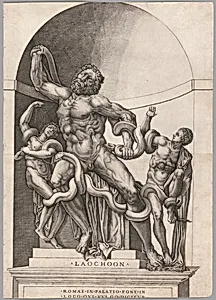
Upon the arrival of the Trojan Horse, Laöcoon, a Trojan priest of Poseidon, suspected foul play and threw a spear at the horse. Rather than revealing the Greek soldiers within, this act unjustly earned him and his young sons a painful death from sea serpents sent by the goddess Athena. This print by Nicolas Beatrizet shows the Hellenistic Greek sculpture (or later copy) unearthed in Rome in 1506 and immediately hailed as a masterpiece of antiquity by artists such as Raphael and Michelangelo. Laö...
Art Historical Context
Nicolas Beatrizet’s engraving *Laocoön*, created between 1540 and 1565, captures one of antiquity’s most dramatic sculptures—the Trojan priest and his sons struggling against sea serpents. Working in Rome during the height of the Renaissance, Beatrizet specialized in reproductive prints that brought celebrated ancient and contemporary works to a wider European audience. His precise burin work translates the marble group’s twisting forms and intense emotion into crisp black lines on cream laid paper, preserving the sculpture’s dynamic composition for study and admiration. Printmaking techniques like engraving were revolutionary in the sixteenth century, allowing images of newly excavated antiquities to circulate quickly among artists, collectors, and scholars. This sheet, measuring roughly 16 by 12 inches, exemplifies how such prints helped shape Renaissance taste by making the classical ideal accessible far beyond Rome. Today it resides in the Art Institute of Chicago’s Department of Prints and Drawings, where it continues to illustrate the enduring dialogue between ancient sculpture and early modern graphic art.
About the Artist
Nicolas Beatrizet · 1515–1566
Nicolas Beatrizet, born around 1515 in Lunéville, Lorraine (then part of the Holy Roman Empire), emerged as one of the most prolific French engravers of the 16th century. Little is known about his early life and training, with no records of specific teachers or apprenticeships, though regional influences from German and Italian printmaking likely shaped his skills before he arrived in Rome around ...