
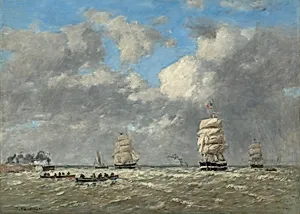
Le Havre
1883
Medium
oil on canvas
Dimensions
overall: 52.39 × 72.87 cm (20 5/8 × 28 11/16 in.) framed: 83.19 × 103.51 × 10.8 cm (32 3/4 × 40 3/4 × 4 1/4 in.)
Classification
Painting
Department
CF
Museum
National Gallery of Art, Washington, D.C.
Credit
Corcoran Collection (Edward C. and Mary Walker Collection)
Accession Number
2015.19.58
Rights
Public Domain
Art Historical Context
Eugène Boudin *Le Havre* (1883) captures the bustling port city of Le Havre, a vital hub on France’s Normandy coast, through the artist’s masterful touch. Born nearby in Honfleur in 1824, Boudin was a of plein-air painting, often working directly from nature to seize fleeting atmospheric effects. This oil on canvas, measuring about 52 x 73 cm, likely evokes the harbor’s lively energy—ships, sails billowing in the breeze, and expansive skies that Boudin adored—rendered with his signature loose brushwork and luminous color. As a precursor to Impressionism, Boudin profoundly influenced Claude Monet, who apprenticed under him as a youth. His scenes emphasize light’s play on water and clouds, bridging Romanticism’s grandeur with the Impressionists’ focus on everyday transience. Painted late in his career, *Le Havre* reflects Boudin’s lifelong devotion to marine subjects, blending keen observation with poetic sensitivity. Now part of the National Gallery of Art’s Corcoran Collection (Edward C. and Mary Walker Collection), this work invites visitors to feel the salty breeze and ponder the era’s maritime vitality. A testament to Boudin’s enduring legacy, it reminds us how art can distill a place’s spirit into timeless beauty.
About the Artist
Eugène Boudin · 1824–1898
Eugène Louis Boudin was born on July 12, 1824, in Honfleur, Normandy, the son of a harbor pilot. When his family relocated to Le Havre, his father opened a stationery and picture-framing shop, and it was there that the young Boudin first encountered working artists. Artists such as Constant Troyon and Jean-François Millet recognized his talent and urged him toward a career in art. In 1850, a munic...