
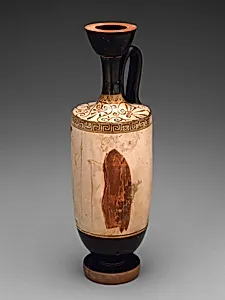
Lekythos (Oil Jar)
445-440 BCE
Medium
terracotta, white-ground
Dimensions
30.8 × 9.8 cm (12 1/8 × 3 7/8 in.); Diam.: 9.8 cm (3 7/8 in.)
Classification
vessel
Department
Arts of Greece, Rome, and Byzantium
Museum
Art Institute of Chicago
Accession Number
111044
Rights
Public Domain
About this artwork
Athenian cemeteries housed a variety of monuments and offerings to the dead. This terracotta vessel, called a lekythos, is one example that held oil. From the middle until the end of the fifth century B.C., they were usually decorated in a distinctive technique known as white ground, so called after the light slip coating on the body and shoulder of the vase. Atop this, figures were usually drawn in outline and then painted in rich colors, many of which have since faded. Since most of these bott...
Art Historical Context
This elegant lekythos, or oil jar, was crafted by the Achilles Painter around 445–440 BCE Athens during Greece’s Classical. Standing just over a foot tall, the terracotta vessel features the white-ground technique, in a layer of white slip covers the surface to create a pale background for delicate figural scenes. The Achilles Painter was renowned for his refined draftsmanship in this medium, producing works that balanced graceful lines with subtle color washes. White-ground lekythoi like this one held special cultural significance as funerary offerings. Unlike the more durable black- or red-figure vases used in daily life, these vessels were often placed in tombs or at gravesites, their fragile surfaces suited to ritual rather than practical use. The technique allowed artists to depict intimate moments—mourners, mythological figures, or quiet domestic scenes—with a softness that evoked both beauty and transience. Today housed in the Art Institute of Chicago’s collection of Greek, Roman, and Byzantine art, the vessel offers visitors a direct connection to ancient Athenian beliefs about death and remembrance. Its modest size and refined execution highlight the high regard Athenians placed on honoring the deceased through thoughtfully crafted objects.
About the Artist
Achilles Painter
**The Achilles Painter** was a leading Athenian vase painter of the Classical period, active approximately from 470 to 425 BC. His conventional name derives from his name vase, a red-figure amphora (Vatican 16571) now in the Vatican Museums that depicts the hero Achilles in a pensive, armored pose, dated around 450–445 BC. As an Attic artist working in the red-figure technique, he produced works t...