
L'har-e-tar-rúshe, Ill-natured Man, a Skidi (Wolf) Pawnee
1832
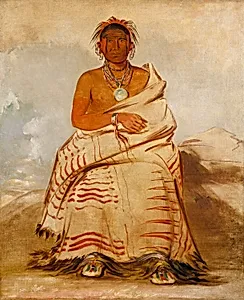
Medium
Painting
Classification
Painting
Department
Smithsonian Collection
Museum
Smithsonian American Art Museum
Credit
Smithsonian American Art Museum, Gift of Mrs. Joseph Harrison, Jr.
Accession Number
1985.66.111
Rights
Public Domain
Tags
About this artwork
George Catlin probably painted these images of Pawnee chiefs and warriors at Fort Leavenworth (in today’s Kansas) in 1832. He later described the tribe as: “A very powerful and warlike nation, living on the river Platte, about one hundred miles from its junction with the Missouri; laying claim to, and exercising sway over, the whole country, from its mouth to the base of the Rocky Mountains. The present number of this tribe is ten or twelve thousand; about one half the number they had in 1832, w...
Art Historical Context
In 1832, George Catlin captured the striking portrait *L'har-e-tar-rúshe, Ill-n Man, a Skidi (Wolf) Pawnee* at Fort Leavenworth in-day Kansas. This full depiction showcases a warrior from the Skidi band of the Pawnee tribe adorned with intricate jewelry that highlights their cultural regalia. Catlin, a pioneering 19th American artist, devoted his career to documenting Native American life through realistic oil portraits, creating his renowned "Indian Gallery" to preserve vanishing traditions amid rapid Western expansion. Painted during Catlin's travels along the Platte River, the work reflects the Pawnee's formidable presence as a "very powerful and warlike nation" controlling vast territories to the Rocky Mountains. Tragically, Catlin noted their population had halved from 1832 levels due to smallpox introduced by fur traders and whiskey sellers, fueling their reputation for hostility. This portrait, now in the Smithsonian American Art Museum, embodies Catlin's urgent mission to record indigenous dignity and diversity before irreversible losses. Catlin's precise, ethnographic style—emphasizing pose, attire, and expression—offers invaluable insight into Pawnee identity, making this a poignant artifact of early American frontier encounters.
About the Artist
George Catlin · 1796–1872
George Catlin (1796–1872), born in Wilkes-Barre, Pennsylvania, to Putnam Catlin and Polly Sutton—who had been captured by Native Americans during the 1778 Battle of Wyoming—initially pursued a legal career. Trained at Litchfield Law School, he was admitted to the bar in 1819 but abandoned law after two years to study art in Philadelphia in 1823. Self-taught as a portraitist, Catlin quickly gained ...