
Lionardo
Medium
engraving on laid paper
Dimensions
sheet (trimmed to plate mark): 13 × 8 cm (5 1/8 × 3 1/8 in.)
Classification
Department
CG-E
Museum
National Gallery of Art, Washington, D.C.
Credit
R.L. Baumfeld Collection
Accession Number
1969.15.323
Rights
Public Domain
Art Historical Context
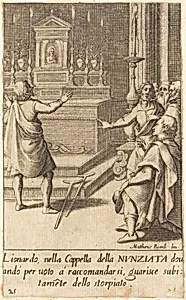
This delicate engraving titled *Lionardo*, created in 1619 by Jacques Callot after a design by Matteo Rosselli, offers a striking portrait of the Renaissance master Leonardo da Vinci. Measuring just 13 by 8 centimeters, the print captures the famed artist and inventor with refined detail, reflecting Callot’s mastery of translating painted or drawn sources into intricate printed form. As a reproductive engraving, it helped circulate Leonardo’s image across Europe at a time when original works were accessible to only a privileged few. Callot, a leading printmaker of the early Baroque era, trained in Italy and brought extraordinary precision to the medium of engraving on laid paper. His fine lines and careful shading convey both the texture of Leonardo’s hair and beard and the thoughtful expression in his eyes, demonstrating how prints could preserve and popularize cultural icons. Produced during Callot’s formative years in Florence, the work bridges the worlds of 16th-century Florentine painting and the expanding print culture of the 17th century. Today housed in the National Gallery of Art’s collection as part of the R.L. Baumfeld gift, this modest sheet reminds visitors of printmaking’s vital role in shaping artistic reputations. Its intimate scale invites close looking, revealing how a single engraved portrait could carry Leonardo’s legacy into new generations.