
7/7
Medium
pen
Dimensions
104; 62
Rights
Public Domain
About this artwork
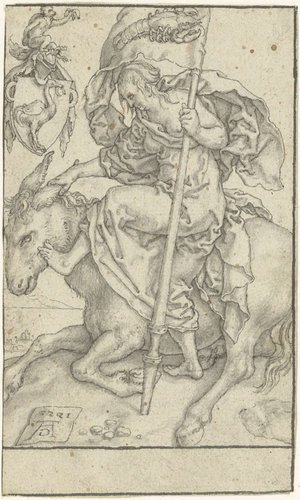
Ontwerp voor een prent.
Art Historical Context
Heinrich Aldegrever, a prominent German engraver andsmith of the Renaissance (. 1502–5/61), created *7/7* in 1552 as a delicate pen drawing measuring just 104 mm high by 62 mm wide. One of the "Little Masters" known for their intricate small-scale prints, Aldegrever in Soest, Westphalia, Northern Renaissance precision with ornamental flair. This piece, titled "7/7," likely marks the final design in a series of seven, a common format for his thematic engravings that explored motifs from daily life, allegory, or biblical scenes. Rendered in pen, *7/7* served as an "ontwerp voor een prent"—a preparatory study for an engraving. Such drawings highlight Aldegrever's mastery of line work, where fine hatching and cross-hatching built texture and depth on a miniature scale. These designs were crucial in the printmaking process of the 16th century, allowing artists to refine compositions before committing to copper plates, which were then used to produce affordable multiples for collectors across Europe. This intimate artwork exemplifies the era's booming print culture, democratizing art beyond elite patrons. Visitors can appreciate how Aldegrever's meticulous pen strokes capture the technical virtuosity that made his engravings prized heirlooms, bridging craftsmanship and emerging mass media.
About the Artist
Heinrich Aldegrever · 1502–1561
Heinrich Aldegrever, born in 1502 in Paderborn, Westphalia, to parents Herman and Katherine Trippenmeker—a family of clog-makers known by the dialect name Trippenmecker—emerged as a multifaceted artist in the German Renaissance. His early training remains undocumented, though he likely apprenticed in a Soest goldsmith's workshop after relocating there around 1525, where he joined the painters' gui...