
Luiheid
Medium
engraving
Dimensions
103; 62
Rights
Public Domain
About this artwork
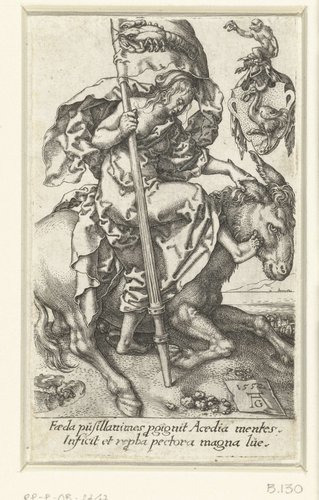
Personificatie van luiheid. Vrouw staand naast een liggend ezel, trekt aan het oor van het dier en schopt hem tegen het hoofd. In haar rechterhand een vaandel met een afbeelding van een kreeft. Rechtsboven een wapenschild met een struisvogel met een hoefijzer in zijn bek, daarboven een aap met een hoefijzer. Onder de prent een tweeregelige tekst in het Latijn. Zevende prent uit een serie van zeven.
Art Historical Context
**Luiheid (Sloth)** by Heinrich Aldegre (1552) is a captivating small-scale engraving, measuring just 103 × 62 mm, that vividly personifies one of the seven deadly sins Created during the Northern Renaissance, it depicts a stern woman embodying laziness, standing beside a recumbent donkey—the classic symbol sloth. She tugs sharply at the animal's ear and kicks its head, urging it to rise, while clutching a banner adorned with a crab, evoking sluggishness and backward movement. This dynamic scene serves as a moral wake-up call, common in 16th-century didactic art. As the seventh print in a series of seven, *Luiheid* likely illustrates the vices, drawing from medieval Christian allegory to instruct viewers on ethical living. Aldegrever, a master engraver from Soest, Germany, and one of the "Little Masters," excelled in intricate copperplate engravings like this one. His fine lines capture expressive details—the woman's determined posture, the donkey's limp form—allowing widespread dissemination of moral lessons through affordable prints. Upper right, a coat of arms features an ostrich clutching a horseshoe in its beak, topped by a monkey with another, possibly alluding to a patron or emblem of tenacity contrasting sloth. A two-line Latin inscription below reinforces the print's cautionary message. This work highlights engraving's power in the Renaissance print revolution, blending artistry with cultural critique to engage everyday audiences in timeless virtues.
About the Artist
Heinrich Aldegrever · 1502–1561
Heinrich Aldegrever, born in 1502 in Paderborn, Westphalia, to parents Herman and Katherine Trippenmeker—a family of clog-makers known by the dialect name Trippenmecker—emerged as a multifaceted artist in the German Renaissance. His early training remains undocumented, though he likely apprenticed in a Soest goldsmith's workshop after relocating there around 1525, where he joined the painters' gui...