
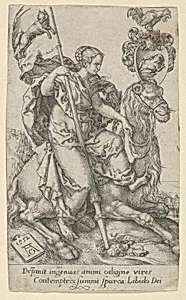
Lust, from The Vices
Medium
Engraving
Dimensions
Sheet: 4 × 2 7/16 in. (10.2 × 6.2 cm)
Classification
Prints
Department
Drawings and Prints
Museum
Metropolitan Museum of Art, New York, NY
Credit
Gift of Felix M. Warburg and his family, 1941
Accession Number
41.1.108
Rights
Public Domain
Tags
Art Historical Context
Heinrich Aldegrever's *Lust, from The Vices* (1552) is a exquisite small-scale engraving, measuring just 4 × 2 7/16 inches, exemplifying the meticulous craft of the Northern Renaissance "Little Masters."egrever, a German printmaker from Soest, was renowned for his intricate engravings that blended moral allegory with ornamental detail, making fine art accessible through affordable prints. This piece belongs to a series personifying the seven deadly vices a popular didactic theme in 16th-century Europe amid the Protestant Reformation's emphasis on personal morality. The composition features symbolic elements like women, chickens, camels, frogs, and a coat of arms, likely depicting Lust as a seductive female figure amid creatures evoking sensuality, excess, or folly—common in emblematic art of the era. Aldegrever's engraving technique shines here: fine burin lines create texture and depth on a tiny sheet, allowing for rich narrative density that rewarded close viewing. Housed in the Metropolitan Museum of Art's Drawings and Prints department (gift of Felix M. Warburg and family, 1941), this work highlights printmaking's role in disseminating ethical lessons to a broad audience, from burghers to collectors. Its survival offers a window into Renaissance visual culture's blend of beauty and cautionary tale.
About the Artist
Heinrich Aldegrever · 1502–1561
Heinrich Aldegrever, born in 1502 in Paderborn, Westphalia, to parents Herman and Katherine Trippenmeker—a family of clog-makers known by the dialect name Trippenmecker—emerged as a multifaceted artist in the German Renaissance. His early training remains undocumented, though he likely apprenticed in a Soest goldsmith's workshop after relocating there around 1525, where he joined the painters' gui...