
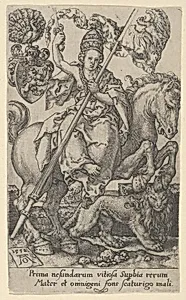
Pride, from The Vices
Medium
Engraving
Dimensions
Sheet: 4 × 2 7/16 in. (10.2 × 6.2 cm)
Classification
Prints
Department
Drawings and Prints
Museum
Metropolitan Museum of Art, New York, NY
Credit
Gift of Felix M. Warburg and his family, 1941
Accession Number
41.1.105
Rights
Public Domain
Tags
Art Historical Context
Behold *Pride, from The Vices*, a masterful 1552 engraving by Heinrich Aldrever, one of the renowned "Little Masters" of the Northern Renaissance. This small yet intricate print (just 4 × 2 7/16 inches) belongs to a series personifying the Seven Deadly Sins a popular moralistic theme in 16th-century German art. Aldegrever, a goldsmith-turned-engraver from Soest, Westphalia, captured the era's fascination with allegory, blending religious instruction with virtuoso printmaking to reach a wide audience through affordable reproductions. Engraving's fine lines allowed Aldegrever to render exquisite details, evident in the symbolic motifs: a proud woman flanked by a strutting peacock (vanity's emblem), a majestic horse, and a fierce lion, all evoking hubris and worldly ostentation. These elements reflect Renaissance humanism's tension between earthly desires and spiritual virtue, influenced by medieval traditions and the Reformation's call for moral vigilance. Housed in the Metropolitan Museum of Art's Drawings and Prints department (gift of Felix M. Warburg and family, 1941), this work showcases how prints democratized art, educating viewers on vice's folly. A tiny gem that packs a timeless warning!
About the Artist
Heinrich Aldegrever · 1502–1561
Heinrich Aldegrever, born in 1502 in Paderborn, Westphalia, to parents Herman and Katherine Trippenmeker—a family of clog-makers known by the dialect name Trippenmecker—emerged as a multifaceted artist in the German Renaissance. His early training remains undocumented, though he likely apprenticed in a Soest goldsmith's workshop after relocating there around 1525, where he joined the painters' gui...