
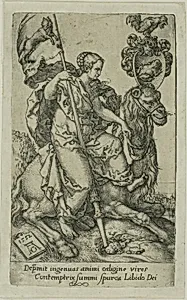
Lust, from the Vices
Medium
Engraving in black on ivory laid paper
Dimensions
Image/plate: 10.2 × 6.1 cm (4 1/16 × 2 7/16 in.)
Classification
engraving
Department
Prints and Drawings
Museum
Art Institute of Chicago
Accession Number
77409
Rights
Public Domain
Art Historical Context
**Lust, from the Vices** Heinrich Aldegrever, 1552 Engraving in black on ivory laid paper Image/plate: 10.2 × 6.1 cm (4 1/16 × 2 7/16 in.) Art Institute of Chicago, Prints and Drawings Department Heinrich Aldegrever, a leading German engraver of the Northern Renaissance, crafted this intimate engraving as part of his renowned *Vices* series around 1552. Working in Soest, Westphalia, Aldegrever was one of the "Little Masters," artists celebrated for their virtuosic small-scale prints that rivaled painting in detail. This moralistic allegory embodies *Lust* (Luxuria), one of the seven deadly sins, reflecting the era's deep Catholic preoccupation with vice and virtue amid Reformation tensions. The engraving's black lines on creamy ivory laid paper showcase Aldegrever's mastery of the burin technique, incising fine, precise lines into a copper plate for richly textured effects—from swirling drapery to expressive figures. At just over four inches tall, its compact size made it ideal for collectors' albums or devotional study, democratizing high art through affordable prints. This piece highlights engraving's revolutionary role in 16th-century Europe, spreading complex iconography to wider audiences and influencing later printmakers like Albrecht Dürer. Today, *Lust* captivates with its vivid narrative punch, inviting reflection on timeless human frailties. A gem in the Art Institute of Chicago's collection, it reminds us how Renaissance artists used art as a mirror to the soul.
About the Artist
Heinrich Aldegrever · 1502–1561
Heinrich Aldegrever, born in 1502 in Paderborn, Westphalia, to parents Herman and Katherine Trippenmeker—a family of clog-makers known by the dialect name Trippenmecker—emerged as a multifaceted artist in the German Renaissance. His early training remains undocumented, though he likely apprenticed in a Soest goldsmith's workshop after relocating there around 1525, where he joined the painters' gui...