
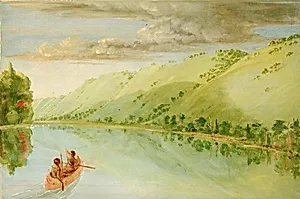
Madame Ferrebault's Prairie, above Prairie du Chien
1835-1836
Medium
Painting
Classification
Painting
Department
Smithsonian Collection
Museum
Smithsonian American Art Museum
Credit
Smithsonian American Art Museum, Gift of Mrs. Joseph Harrison, Jr.
Accession Number
1985.66.322
Rights
Public Domain
Tags
About this artwork
In addition to portraits of Native Americans, George Catlin captured images of the western landscape, and recorded his responses to the West’s remarkable beauty in his travel account Letters and Notes. Here, he describes his journey on the Upper Mississippi in 1835: “The traveller in ascending the river, will see but little of picturesque beauty in the landscape, until be reaches Rock Island; and from that point he will find it growing gradually more interesting, until he reaches Prairie du Chie...
Art Historical Context
George Catlin, a pioneering 19th-century American artist painted *Madame Ferrebault's, above Prairie du Chien during his 1835-1836 expedition up the Upper Mississippi River. known for his portraits of Native Americans, Cat also sought to document the untamed beauty of the American West before industrialization and settlement transformed it. This oil painting, now in the Smithsonian American Art, captures a sweeping prairie landscape near the historic fur-trading post of Prairie du Chien in present-day Wisconsin, evoking the sense of awe he experienced firsthand. In his travelogue *Letters and Notes on the Manners, Customs, and Conditions of the North American Indians*, Catlin vividly described the region's escalating grandeur: from Rock Island onward, towering bluffs alternated with the river's bends, forming "countless fascinating forms" that held the eye in "listless, tireless admiration." The artwork likely features these elements—a vast plain, winding river, canoe, and perhaps Native figures—highlighting the pristine harmony of nature and indigenous life. Catlin's work holds enduring cultural significance as an early visual record of a vanishing frontier, blending Romantic admiration for wilderness with ethnographic intent. For visitors, it offers a window into 1830s America, inviting reflection on how such majestic scenes shaped national identity.
About the Artist
George Catlin · 1796–1872
George Catlin (1796–1872), born in Wilkes-Barre, Pennsylvania, to Putnam Catlin and Polly Sutton—who had been captured by Native Americans during the 1778 Battle of Wyoming—initially pursued a legal career. Trained at Litchfield Law School, he was admitted to the bar in 1819 but abandoned law after two years to study art in Philadelphia in 1823. Self-taught as a portraitist, Catlin quickly gained ...