
Mah-táhp-ta-a, Rushes through the Middle, a Brave
1832
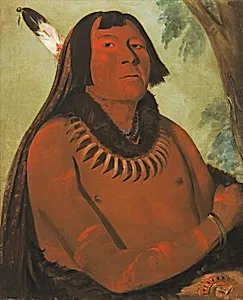
Medium
Painting
Classification
Painting
Department
Smithsonian Collection
Museum
Smithsonian American Art Museum
Credit
Smithsonian American Art Museum, Gift of Mrs. Joseph Harrison, Jr.
Accession Number
1985.66.130
Rights
Public Domain
Tags
About this artwork
“The Mandans (or See-pohs-kah-nu-mah-kah-kee, ‘people of the pheasants,’ as they call themselves), are perhaps one of the most ancient tribes of Indians in our country. Their origin, like that of all the other tribes is from necessity, involved in mystery and obscurity . . . They take great pride in relating their traditions, with regard to their origin; contending that they were the first people created on earth. Their existence in these regions has not been from a very ancient period; and, fro...
Art Historical Context
In 1832, George Catlin, a pioneering American artist dedicated to documenting Native American life, captured this striking portrait of Mah-tá-ta-a, known as "Rushes through Middle, a Brave," during his visit to a Mandan village along the Upper Missouri River.lin, famous for his realistic oil paintings that form his renowned "Indian Gallery," sought to preserve the customs and visages of tribes like the Mand before European influence forever altered them. This work exemplifies his ethnographic approach, blending portraiture with cultural observation. The Mandans, whom Catlin described as the "See-pohs-kah-nu-mah-kah-kee" or "people of the pheasants," took immense pride in their ancient traditions, claiming to be among the first peoples created on earth. Once a powerful nation, they had dwindled due to relentless wars with neighboring tribes. Catlin's on-site painting highlights the bravery and dignity of this warrior, offering a poignant glimpse into Mandan society. Today, housed in the Smithsonian American Art Museum, the portrait stands as a vital historical record of a resilient culture on the cusp of profound change.
About the Artist
George Catlin · 1796–1872
George Catlin (1796–1872), born in Wilkes-Barre, Pennsylvania, to Putnam Catlin and Polly Sutton—who had been captured by Native Americans during the 1778 Battle of Wyoming—initially pursued a legal career. Trained at Litchfield Law School, he was admitted to the bar in 1819 but abandoned law after two years to study art in Philadelphia in 1823. Self-taught as a portraitist, Catlin quickly gained ...