
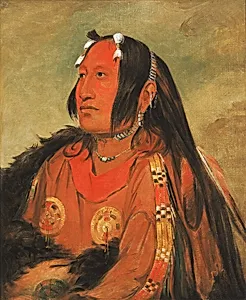
Wi-jún-jon, Pigeon's Egg Head (The Light), a Distinguished Young Warrior
1831
Medium
Painting
Classification
Painting
Department
Smithsonian Collection
Museum
Smithsonian American Art Museum
Credit
Smithsonian American Art Museum, Gift of Mrs. Joseph Harrison, Jr.
Accession Number
1985.66.179
Rights
Public Domain
Tags
About this artwork
George Catlin first met Wi-jún-jon (also called the Light) in St. Louis in December 1831, when the Assiniboine warrior was en route to Washington to meet President Andrew Jackson and tour the city. Catlin recalled that the warrior appeared for his portrait sitting “plumed and tinted . . . [and] dressed in his native costume, which was classic and exceedingly beautiful”---attributes nicely captured in this finished portrait. Wi-jún-jon returned home to the northern Plains eighteen months later a ...
Art Historical Context
In 1831, George Catlin, the pioneering American artist renowned for his vivid portraits of Native American life, captured the striking likeness of Wi-jún-jon, known as "Pigeon's Egg Head (The Light a distinguished young Assiniboine warrior Catlin met him in St Louis as Wi-jún-jon traveled to Washington, D.C., to meet President Jackson and tour the city Dressed in his "classic and exceedingly beautiful" native costume—plumed, tinted, and ornate—the warrior posed for this oil painting, which beautifully preserves his pre-contact dignity and elegance. Catlin's work, part of his ambitious effort to document vanishing Indigenous cultures before Western influence overwhelmed them, exemplifies his realist style and commitment to authenticity. This portrait from the Smithsonian American Art Museum highlights the Assiniboine leader's poised features and traditional regalia, offering a window into Plains Indian life in the early 19th century. Tragically, Wi-jún-jon returned home 18 months later transformed, clad in what appeared to be a "general's" uniform and regaling his people with tales of white men's cities. Deemed "ingenious fabrications," his stories led to his rejection and eventual murder by his own tribe, underscoring the profound cultural clashes of the era. This artwork stands as both a celebration and a poignant reminder of that irreversible change.
About the Artist
George Catlin · 1796–1872
George Catlin (1796–1872), born in Wilkes-Barre, Pennsylvania, to Putnam Catlin and Polly Sutton—who had been captured by Native Americans during the 1778 Battle of Wyoming—initially pursued a legal career. Trained at Litchfield Law School, he was admitted to the bar in 1819 but abandoned law after two years to study art in Philadelphia in 1823. Self-taught as a portraitist, Catlin quickly gained ...