
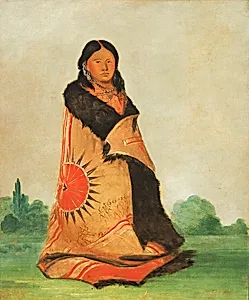
Mong-shóng-sha, Bending Willow, Wife of Great Chief
1832
Medium
Painting
Classification
Painting
Department
Smithsonian Collection
Museum
Smithsonian American Art Museum
Credit
Smithsonian American Art Museum, Gift of Mrs. Joseph Harrison, Jr.
Accession Number
1985.66.98
Rights
Public Domain
Tags
About this artwork
“I visited the wigwam of [Great Chief] . . . several times,” George Catlin wrote, “and saw his four modest little wives seated around the fire, where all seemed to harmonize very well; . . . I selected [Bending Willow] . . . for her portrait, and painted it . . . in a very pretty dress of deer skins, and covered with a young buffalo's robe, which was handsomely ornamented, and worn with much grace and pleasing effect.” The artist painted this portrait at a Ponca village in 1832. (Catlin, Letters...
Art Historical Context
In 1832, renowned artist George Catlin painted *Mong-shóng-sha,ending Willow, Wife of Chief* during his travels among the Ponca people in their village along the Missouri River. Catlin, a pioneering chronicler of Native American life in the early 19th century, to capture the dignity and daily realities of Indigenous cultures before widespread European settlement altered them forever. This oil portrait depicts Bending Willow, one of four wives of a Ponca chief, seated in a deer-skin dress adorned with a handsomely ornamented young buffalo robe, as described by the artist himself. Catlin's firsthand account reveals the intimate setting: "I visited the wigwam of [Great Chief] several times... and saw his four modest little wives seated around the fire, where all seemed to harmonize very well." He selected Bending Willow for her portrait, emphasizing her poise and the cultural significance of her attire—symbols of Ponca tradition and status. As part of Catlin's vast gallery of over 600 Native portraits, this work exemplifies his Romantic style: realistic yet idealized, blending ethnographic detail with artistic flair to preserve vanishing ways of life. Today, housed in the Smithsonian American Art Museum, the painting offers a poignant window into Ponca society and Catlin's urgent mission to document it, reminding visitors of the rich humanity in these early encounters.
About the Artist
George Catlin · 1796–1872
George Catlin (1796–1872), born in Wilkes-Barre, Pennsylvania, to Putnam Catlin and Polly Sutton—who had been captured by Native Americans during the 1778 Battle of Wyoming—initially pursued a legal career. Trained at Litchfield Law School, he was admitted to the bar in 1819 but abandoned law after two years to study art in Philadelphia in 1823. Self-taught as a portraitist, Catlin quickly gained ...