
Ah'-kay-ee-pix-en, Woman Who Strikes Many
1832
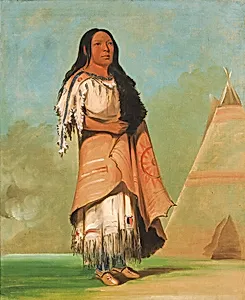
Medium
Painting
Classification
Painting
Department
Smithsonian Collection
Museum
Smithsonian American Art Museum
Credit
Smithsonian American Art Museum, Gift of Mrs. Joseph Harrison, Jr.
Accession Number
1985.66.155
Rights
Public Domain
Tags
About this artwork
George Catlin painted Woman Who Strikes Many, a member of the Blackfoot/Siksika tribe, in 1832 at Fort Union, two thousand miles northwest of St. Louis, in the heart of Blackfoot and Crow country. He later wrote that she wore “a beautiful dress of the mountain-goats’ skin, and her robe of the young buffalo’s hide.” (Catlin, Letters and Notes, vol. 1, no. 5, 1841, reprint 1973; Truettner, The Natural Man Observed, 1979)
Art Historical Context
In 1832, renowned artist George Catlin captured dignified likeness of Ah'-kay-ee-pix-en, known as "Woman Who Strikes," a member of the Blackfoot (iksika) tribe. at remote Fort Union Trading Post—two thousand miles northwest of St. Louis deep in Blackfoot and Crow territory—this portrait is part of Catlin's ambitious mission to document Native American life and customs before widespread European American encroachment. As a pioneering ethnographer-artist, Catlin traveled across the Great Plains, creating over 600 portraits that offer invaluable glimpses into Indigenous cultures of the early 19th century. Catlin himself described her striking attire in his *Letters and Notes*: a "beautiful dress of the mountain-goats’ skin" paired with a robe of young buffalo hide, materials sourced from the rugged landscapes she called home. Rendered in oil on canvas, the painting exemplifies Catlin's realistic style, blending portraiture with anthropological detail to honor his subjects' individuality and regalia. Today, housed in the Smithsonian American Art Museum, this work underscores the cultural resilience of Blackfoot women and Catlin's urgent plea to preserve vanishing traditions. It invites visitors to reflect on the humanity and artistry of First Nations peoples amid a transformative era.
About the Artist
George Catlin · 1796–1872
George Catlin (1796–1872), born in Wilkes-Barre, Pennsylvania, to Putnam Catlin and Polly Sutton—who had been captured by Native Americans during the 1778 Battle of Wyoming—initially pursued a legal career. Trained at Litchfield Law School, he was admitted to the bar in 1819 but abandoned law after two years to study art in Philadelphia in 1823. Self-taught as a portraitist, Catlin quickly gained ...