
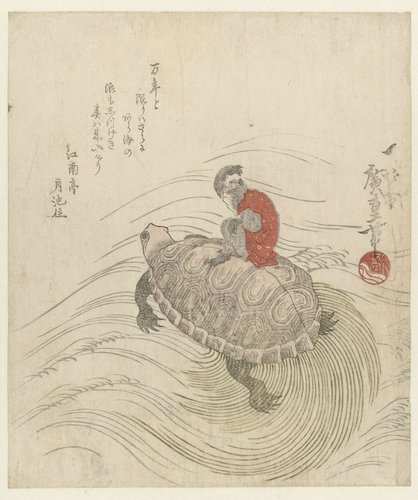
Monkey and Turtle
Medium
nishikie, with metallic pigments
Dimensions
214; 181
Rights
Public Domain
About this artwork
Purchased with the support of the F.G. Waller-Fonds
Art Historical Context
**Monkey and Turtle** is a delightful early woodblock print by Utagawa Hiroshige I1797–1858), a master of ukiyo-e, Japan's vibrant "pictures of the floating world" tradition. Created in 1824, this nishikie—meaning "brocade picture"—measures just 214 mm high by 181 mm wide, showcasing the intricate multi-color printing techniques that revolutionized Japanese art during the Edo period (1603–1868). The of metallic pigments lends a luxurious shimmer, evoking the opulence of surimono, privately commissioned New Year's prints often exchanged among literati. Hiroshige, who later gained fame for his evocative landscapes like *The Fifty-three Stations of the Tōkaidō*, here captures a whimsical scene from Japanese folklore featuring a monkey and turtle. Such animal fables, rooted in Buddhist and Confucian tales, often highlight themes of cleverness, greed, and retribution—the monkey's trickery on the turtle serving as a moral lesson. The nishikie medium's layered colors and fine details reflect the collaborative genius of ukiyo-e workshops, where carvers, printers, and publishers created accessible yet exquisite art for urban audiences. Acquired with support from the F.G. Waller-Fonds, this print exemplifies Hiroshige's youthful versatility before his landscape mastery. Its cultural resonance endures, bridging everyday entertainment with profound storytelling in Japan's golden age of printmaking.