
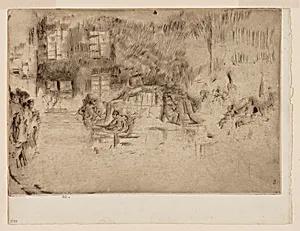
Murano - Glass Furnace
1879/80
Medium
Drypoint in black ink on off-white laid paper
Dimensions
Plate: 16 × 23.4 cm (6 5/16 × 9 1/4 in.); Sheet: 18.5 × 24.3 cm (7 5/16 × 9 5/8 in.)
Classification
drypoint
Department
Prints and Drawings
Museum
Art Institute of Chicago
Accession Number
73471
Rights
Public Domain
Art Historical Context
James McNeill Whistler’s *Murano - Glass Furnace* (1879/80) captures the industrious glow of Venice’s nearby island of Murano, renowned for its-old glassmaking tradition. Created during Whistler’s Venetian sojourn, this drypoint print depicts the dramatic interior of a glass furnace, where molten glass takes shape amid flickering flames and shadowy figures. Whistler, a master of tone and subtlety associated with the Aesthetic movement, favored such intimate, atmospheric scenes to evoke mood over literal detail. The artwork’s medium—drypoint in black ink on off-white laid paper—highlights Whistler’s innovative printmaking prowess. Unlike etching, drypoint involves scratching directly into a metal plate with a sharp tool, producing a rich, velvety line quality from the burr of raised metal that holds ink. This technique allowed for spontaneous, expressive marks, yielding only a handful of impressions before the delicate burr wore down, making each print uniquely textured. Measuring a modest plate size of 16 × 23.4 cm, it exemplifies Whistler’s shift toward print as fine art. Housed in the Art Institute of Chicago’s Prints and Drawings department, *Murano - Glass Furnace* reflects the late 19th-century fascination with craft and industry, bridging Whistler’s cosmopolitan eye with Murano’s artisanal heritage. A testament to his technical virtuosity, it invites viewers to linger on its smoky depths and luminous sparks.
About the Artist
James McNeill Whistler · 1834–1903
James Abbott McNeill Whistler (1834-1903) was an American-born painter and printmaker who became a leading figure in the Aesthetic Movement and pioneer of Tonalism and Japonisme. He revolutionized art by championing "art for art's sake" and treating paintings as visual equivalents of musical compositions, titling works as "arrangements," "harmonies," and "nocturnes" to emphasize formal qualities o...