
Naugh-háigh-hee-kaw, He Who Moistens the Wood
1828
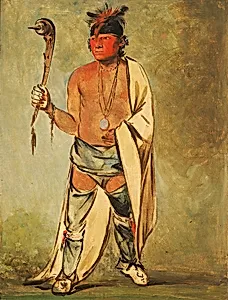
Medium
Painting
Classification
Painting
Department
Smithsonian Collection
Museum
Smithsonian American Art Museum
Credit
Smithsonian American Art Museum, Gift of Mrs. Joseph Harrison, Jr.
Accession Number
1985.66.217
Rights
Public Domain
Tags
About this artwork
Before George Catlin began his extensive travels in the West, he spent time in eastern cities, where he often saw visiting delegations of Native Americans and painted their portraits. Nine members of a Winnebago delegation, including He Who Breaks the Bushes and He Who Moistens the Wood, sat for him in Washington, D.C., in 1828. Three years later, also in the capital, the artist painted Menominee and Seneca delegations, including a portrait of the Menominee Másh-kee-wet, whom the artist called i...
Art Historical Context
In 1828, George Catlin painted *Naugh-háigh-hee-kaw, He Who Moistens the Wood*, striking portrait of a Winneb (Ho-Chunk) leader Washington, D.C. as part of a delegation At this early stage in his career, Catlin was a portrait painter in eastern cities, capturing the likenesses of Native Americanitaries who traveled east for treaty negotiations and diplomatic meetings. This work is one of nine portraits from that Winnebago group, showcasing the subject in traditional attire that Catlin later described as "arrayed and equipped in all their classic beauty... exactly for the painter’s palette." The painting marks a pivotal moment for Catlin, who was searching for a lifelong artistic pursuit. These encounters with vibrant delegations inspired his eventual epic documentation of Native American life in the West. Through oil on canvas, Catlin's precise, realistic style preserved the dignity and cultural splendor of his subjects at a time of rapid change for Indigenous peoples, offering visitors a window into early 19th-century cross-cultural exchanges. Today, housed in the Smithsonian American Art Museum, this portrait highlights the artist's growing fascination with Native cultures, blending ethnographic insight with fine portraiture for enduring historical value.
About the Artist
George Catlin · 1796–1872
George Catlin (1796–1872), born in Wilkes-Barre, Pennsylvania, to Putnam Catlin and Polly Sutton—who had been captured by Native Americans during the 1778 Battle of Wyoming—initially pursued a legal career. Trained at Litchfield Law School, he was admitted to the bar in 1819 but abandoned law after two years to study art in Philadelphia in 1823. Self-taught as a portraitist, Catlin quickly gained ...