
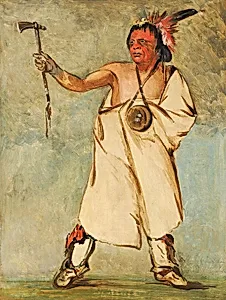
Naw-naw-páy-ee, The Soldier
1828
Medium
Painting
Classification
Painting
Department
Smithsonian Collection
Museum
Smithsonian American Art Museum
Credit
Smithsonian American Art Museum, Gift of Mrs. Joseph Harrison, Jr.
Accession Number
1985.66.212
Rights
Public Domain
Tags
About this artwork
Before he began his extensive travels in the West, George Catlin found his first Indian subjects in the East. Nine members of a Winnebago delegation from present-day Wisconsin sat for him in Washington, D.C., in 1828. Catlin wrote that he had painted the portraits of “Won-de-tow-a (the wonder), Wa-kon-chash-kaw (he who comes on the thunder), Nau-naw-pay-ee (the soldier), Span-e-o-nee-kaw (the Spaniard) Hoo-wan-ee-kaw (the little elk), No-ah-choo-she-kaw (he who breaks the bushes), and Naugh-haig...
Art Historical Context
In 1828, before embarking on his legendary journeys across the American West, artist George Catlin captured the dignified likeness of Naw-naw-páy-ee, known as "The Soldier," a prominent member of the Winnebago (Ho-Chunk) tribe from present-day Wisconsin. This full-length portrait depicts one of nine tribal leaders who traveled to Washington, D.C., as part of a delegation. Catlin, a pioneering Romantic painter, meticulously documented these men— including Won-de-tow-a ("the wonder") and Wa-kon-chash-kaw ("he who comes on the thunder")—in oil on canvas, preserving their regal presence and traditional attire for posterity. These early portraits mark the beginning of Catlin's lifelong mission to portray Native American cultures authentically, at a time when U.S. expansion threatened their ways of life. Painted with precise detail and a sense of nobility, the work highlights the Winnebago's cultural pride amid political negotiations in the nation's capital. Today, housed in the Smithsonian American Art Museum, "Naw-naw-páy-ee, The Soldier" stands as a vital historical record, offering visitors a glimpse into Indigenous diplomacy and Catlin's emerging style that blended ethnography with artistry.
About the Artist
George Catlin · 1796–1872
George Catlin (1796–1872), born in Wilkes-Barre, Pennsylvania, to Putnam Catlin and Polly Sutton—who had been captured by Native Americans during the 1778 Battle of Wyoming—initially pursued a legal career. Trained at Litchfield Law School, he was admitted to the bar in 1819 but abandoned law after two years to study art in Philadelphia in 1823. Self-taught as a portraitist, Catlin quickly gained ...