
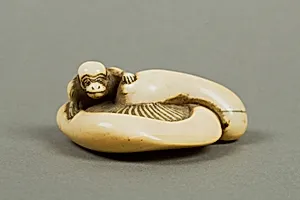
Netsuke of Monkey on a Mushroom
Unknown Artist
18th century
Medium
Ivory
Dimensions
H. 13/16 in. (2.1 cm); W. 1 1/2 in. (3.8 cm); L. 1 3/4 in. (4.4 cm)
Classification
Netsuke
Culture & Period
Japan · Edo period (1615–1868)
Department
Asian Art
Museum
Metropolitan Museum of Art, New York, NY
Credit
Gift of Mrs. Russell Sage, 1910
Accession Number
10.211.256
Rights
Public Domain
Tags
Art Historical Context
This delightful netsuke, carved from ivory in 18th-century Japan during the Edo period (161–1868), captures mischievous monkey perched atop a mushroom. Measuring just 13/16 inches high, 1 1/2 inches wide, and 1 3/4 inches long, its diminutive size belies the extraordinary skill of the unknown artist. Netsuke like this served a practical purpose: as toggles to secure inro (small lacquered cases for medicines or tobacco) or pouches to the sash of a kimono, blending functionality with artistry in everyday life. In the prosperous Edo era, netsuke became a hallmark of merchant culture, evolving from simple fasteners into miniature sculptures prized for their whimsy and detail. Ivory, valued for its smooth texture and workability, allowed carvers to render lifelike fur, expressive faces, and textured mushroom caps with remarkable precision using fine tools. Monkeys, often symbols of cleverness and playfulness in Japanese folklore, add a touch of humor, inviting viewers to appreciate the creature's cheeky pose. Today, this piece from the Metropolitan Museum of Art's Asian Art collection, gifted by Mrs. Russell Sage in 1910, exemplifies the netsuke's cultural significance as wearable art, bridging utility and aesthetic joy in Japan's rich sculptural tradition.