
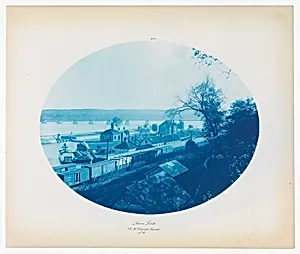
No. 155a. Lower Lock Des Moines Rapids Canal
1891
Medium
Cyanotype
Dimensions
Sheet: 14 1/2 × 17 3/16 in. (36.8 × 43.7 cm)
Classification
Photographs
Department
Photographs
Museum
Metropolitan Museum of Art, New York, NY
Credit
Gift of Charles Wehrenberg and Sally Larsen, 2014
Accession Number
2014.715.9
Rights
Public Domain
Tags
Art Historical Context
Henry P. Bosse’s cyanotype “No. 155a. Lower Lock Des Moines Rapids Canal” (1891) captures a pivotal moment in American infrastructure. The deep Prussian-blue print shows the newly completed lock surrounding canal works along the Mississippi near Keokuk, Iowa, with buildings, rail lines, and the waterway itself. Bosse, a German-born draftsman and photographer employed by the U.S. Army Corps of Engineers, systematically recorded such river-improvement projects in the 1880s and 1890s, producing hundreds of cyanotypes that served both as official engineering records and striking visual documents. Cyanotype, invented in 1842, was prized for its low cost and permanence; its characteristic blue tone made the images instantly legible as working blueprints. Bosse’s large-format sheets—here measuring roughly 14½ by 17 inches—combine crisp architectural detail with atmospheric depth, transforming utilitarian views into quietly powerful landscapes. Today the print stands as both a technical record of 19th-century canal construction and an early example of photography’s role in shaping public understanding of environmental engineering. Acquired by the Metropolitan Museum of Art in 2014, the work highlights how Bosse’s images bridged science and art, preserving the industrial transformation of the American Midwest for future generations.
About the Artist
Henry P. Bosse · 1844–1893
Henry Peter Bosse was born in 1844 in Sonneberg, Prussia (now Germany), and immigrated to the United States around 1870. He settled in the Midwest and joined the U.S. Army Corps of Engineers in 1874 as a draftsman. By the mid-1880s he had risen to chief draftsman in the Rock Island, Illinois, district, where he remained for the rest of his career. His dual expertise in engineering and visual docum...