
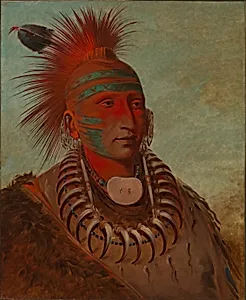
No-ho-mun-ya, One Who Gives No Attention
1844
Medium
Painting
Classification
Painting
Department
Smithsonian Collection
Museum
Smithsonian American Art Museum
Credit
Smithsonian American Art Museum, Gift of Mrs. Joseph Harrison, Jr.
Accession Number
1985.66.522
Rights
Public Domain
Tags
About this artwork
George Catlin described this man as “the finest looking man of the party,” and noted the chief’s “elegant” limbs and “Herculean” frame. The Iowa brave, who was also called “Roman Nose,” died in Liverpool, England, before the Iowa delegation departed for Paris.
Art Historical Context
**No-ho-mun-ya, One Who Gives No Attention (1844) is a striking portrait by George Catlin the pioneering 19th-century American artist for his vivid documentation of Native American life. Catlin, who traveled extensively among tribes in the 1830s, captured the dignity and physical prowess of his subjects in oil paintings that served as both art and ethnography. This work depicts No-ho-mun-ya, an Iowa brave also known asRoman Nose," from a delegation that journeyed to Europe. Tags linking it to Kansas highlight the Iowa people's historical presence in the region during westward expansion. Catlin himself praised No-ho-mun-ya as "the finest looking man of the party," marveling at his "elegant" limbs and "Herculean" frame—a testament to the artist's admiration for Native physicality and grace. Painted during the delegation's time in England, the portrait reflects Catlin's mission to preserve vanishing cultures amid U.S. policies of removal and assimilation. Tragically, No-ho-mun-ya died in Liverpool before the group reached Paris, adding a poignant layer to this image of quiet strength. Housed in the Smithsonian American Art Museum through a generous gift, this painting exemplifies Catlin's realist style, emphasizing facial features and posture to convey character. It invites visitors to reflect on the human stories behind 19th-century encounters between Indigenous peoples and the wider world. (198 words)
About the Artist
George Catlin · 1796–1872
George Catlin (1796–1872), born in Wilkes-Barre, Pennsylvania, to Putnam Catlin and Polly Sutton—who had been captured by Native Americans during the 1778 Battle of Wyoming—initially pursued a legal career. Trained at Litchfield Law School, he was admitted to the bar in 1819 but abandoned law after two years to study art in Philadelphia in 1823. Self-taught as a portraitist, Catlin quickly gained ...