
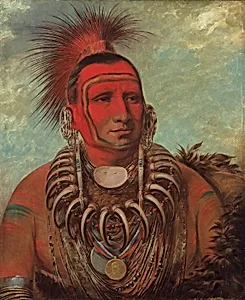
Shon-ta-yi-ga, Little Wolf, a Famous Warrior
1844-1845
Medium
Painting
Classification
Painting
Department
Smithsonian Collection
Museum
Smithsonian American Art Museum
Credit
Smithsonian American Art Museum, Gift of Mrs. Joseph Harrison, Jr.
Accession Number
1985.66.521
Rights
Public Domain
Tags
About this artwork
Between 1844 and 1845, fourteen members of the Iowa tribe joined George Catlin’s tour of London and Paris. In France, their achievements were impressive: the whole party met King Louis Philippe, Catlin installed the Indian Gallery in the Louvre, and he exhibited works in the prestigious Paris Salon. However, Europe held tragedy as well. Several people in Catlin’s entourage died of disease or illness. Shon-ta-yi-ga, an Iowa warrior, experienced heartbreak that paralleled Catlin’s own. Both men lo...
Art Historical Context
George Catlin's portrait *Shon-ta-yi-ga, Little Wolf, a Warrior* (1844–1845) captures the dignified presence of an Iowa tribe leader during a pivotal moment in American art history. Catlin, a pioneering 19th-century artist, devoted his career to documenting Native American life through realistic oil paintings, creating his renowned "Indian Gallery" to vanishing cultures amid westward expansion. This male portrait exemplifies his ethnographic style, emphasizing the subject's regalia, expression, and cultural identity with meticulous detail. Painted amid Catlin's ambitious European tour, the work reflects both triumph and tragedy. In 1844–1845, fourteen Iowa tribespeople accompanied Catlin to London and Paris, where they met King Louis Philippe, his Indian Gallery was displayed in the Louvre, and paintings appeared in the elite Paris Salon. Yet, the journey brought profound loss: Shon-ta-yi-ga endured the deaths of his wife and son from illness, mirroring Catlin's own heartbreak over his family's passing. These events underscored the human cost of Catlin's mission, which later led to his financial ruin and imprisonment for debt in 1852. Today, housed in the Smithsonian American Art Museum, this painting highlights the cultural exchange—and clash—between Indigenous peoples and European audiences, offering a poignant window into Iowa heritage and Catlin's urgent artistic crusade.
About the Artist
George Catlin · 1796–1872
George Catlin (1796–1872), born in Wilkes-Barre, Pennsylvania, to Putnam Catlin and Polly Sutton—who had been captured by Native Americans during the 1778 Battle of Wyoming—initially pursued a legal career. Trained at Litchfield Law School, he was admitted to the bar in 1819 but abandoned law after two years to study art in Philadelphia in 1823. Self-taught as a portraitist, Catlin quickly gained ...