
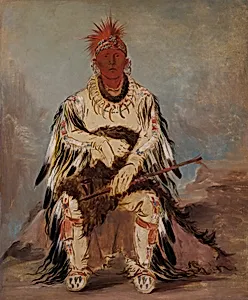
No-wáy-ke-súg-gah, He Who Strikes Two at Once, a Brave
1832
Medium
Painting
Classification
Painting
Department
Smithsonian Collection
Museum
Smithsonian American Art Museum
Credit
Smithsonian American Art Museum, Gift of Mrs. Joseph Harrison, Jr.
Accession Number
1985.66.119
Rights
Public Domain
Tags
About this artwork
George Catlin described this portrait as a “sketch quite unfinished; beautiful dress, trimmed with a profusion of scalp-locks and eagles' quills; pipe in his hand, and necklace of grisly bears' claws.” The degree of finish in this portrait perhaps represents what Catlin hoped to achieve in the single sitting he normally allowed his Indian subjects. The artist probably painted No-wáy-ke-súg-gah at Fort Leavenworth (in today’s Kansas) in 1832. (Catlin, 1848 Catalogue, Catlin’s Indian Gallery, SAAM...
Art Historical Context
George Catlin's *No-wá-y-ke-súg-gah, He Who Strikes Two at Once, Brave* (1832) captures a striking portrait of an Otoe warrior, painted during the artist's ambitious travels across the American West. Catlin, a pioneering 19th-century painter dedicated much of his career to documenting Native American tribes through rapid, on-site sketches, fearing their cultures would vanish amid U.S. expansion. This full-length depiction likely originated at Fort Leavenworth present-day Kansas, amid the fur trade era when military outposts buzzed with tribal interactions. Catlin himself described the work as a "sketch quite unfinished," reflecting his typical single-sitting method to preserve authenticity amid restless subjects. The Otoe brave stands proudly in elaborate regalia: a beautiful dress adorned with scalp-locks and eagles' quills—symbols of valor—while holding a pipe and wearing a necklace of grizzly bear claws. These details highlight Otoe cultural pride and warrior status, rendered in oil with Catlin's characteristic directness and vivid realism. As part of the Smithsonian American Art Museum's collection, this painting endures as a vital ethnographic record, bridging art and history. It invites visitors to ponder the bravery of No-wá-y-ke-súg-gah and the fleeting world Catlin sought to immortalize.
About the Artist
George Catlin · 1796–1872
George Catlin (1796–1872), born in Wilkes-Barre, Pennsylvania, to Putnam Catlin and Polly Sutton—who had been captured by Native Americans during the 1778 Battle of Wyoming—initially pursued a legal career. Trained at Litchfield Law School, he was admitted to the bar in 1819 but abandoned law after two years to study art in Philadelphia in 1823. Self-taught as a portraitist, Catlin quickly gained ...