
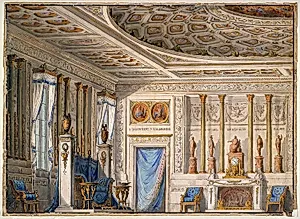
Noble Interior: Stage Design for the Teatro Marsigli-Rossi in Bologna
Classification
theater
Department
Smithsonian Collection
Museum
Smithsonian American Art Museum
Credit
Museum purchase through gift of the Estate of David Wolfe Bishop
Accession Number
1957-195-1
Rights
Public Domain
About this artwork
Research in Progress
Art Historical Context
**Noble Interior: Stage Design for the Teatro Mars-Rossi in Bologna***Antonio Giuseppe Basoli (Italian, 1774–1843), ca. 1810* Antonio Giuseppe Basoli, a prominent Italian architect and scenic designer of the early 19th century, created this evocative stage design around 1810 for the Teatro Marsigli-Rossi in Bologna. Bologna's theaters were hubs of cultural life during the Napoleonic era, blending neoclassical grandeur with emerging romantic sensibilities. Basoli, who worked across Italy and Vienna, specialized in illusionistic perspectives that transformed stages into breathtaking architectural fantasies, drawing audiences into opulent "noble interiors" evoking palaces or grand halls. This work exemplifies the golden age of European theatrical scenography, where designs like Basoli's used precise linear perspective and dramatic lighting to create depth and realism on two-dimensional sets. Though the medium remains under study, such pieces were typically executed in gouache, watercolor, or ink on paper, allowing quick iterations for opera and drama productions. Its presence in the Smithsonian American Art Museum, acquired through a generous gift, highlights the transatlantic appreciation for Italian stagecraft's influence on global performing arts. Fun fact: Basoli's designs often featured intricate architectural details inspired by antiquity, making theaters like Marsigli-Rossi (now lost to history) virtual time machines to imperial splendor. A testament to theater's power as public spectacle! (198 words)