
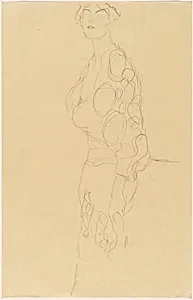
Standing Woman
c. 1910
Medium
graphite on buff wove paper
Dimensions
overall: 50.1 x 32.2 cm (19 3/4 x 12 11/16 in.)
Classification
Drawing
Department
CG-W
Museum
National Gallery of Art, Washington, D.C.
Credit
Gift of Ruth Cole Kainen
Accession Number
2006.160.4
Rights
Public Domain
Art Historical Context
**Standing Woman**, a delicate graphite drawing on buff wove paper by Klimt, captures the artist's masterful exploration of the female form around 1910. Measuring 50.1 x 32.2 cm, this work hails from Klimt's late career, he was a leading figure in Vienna's Secessionist movement—a revolutionary break from academic art that blended Art Nouveau's sinuous lines with Symbolist depth. Klimt, renowned for his ornate gold-leaf paintings like *The Kiss*, often turned to drawings as intimate studies, revealing his fluid, expressive line work unadorned by color or pattern. Created during a period of personal and artistic evolution, the piece exemplifies Klimt's fascination with elongated, graceful female figures, evoking both sensuality and psychological introspection. The buff paper's warm tone enhances the soft shading, lending a luminous quality that foreshadows his painted portraits. Though preparatory drawings like this were typically private, they showcase his technical precision and erotic undercurrents, influencing modernists who followed. Today, *Standing Woman* graces the National Gallery of Art, a generous gift from Ruth Cole Kainen. It invites visitors to appreciate Klimt's genius up close—where every contour tells a story of beauty, rebellion, and the human spirit. (198 words)
About the Artist
Gustav Klimt · 1862–1918
Gustav Klimt was born on July 14, 1862, in Baumgarten near Vienna, the second of seven children in a modest family of artistic bent. His father, Ernst Klimt, a gold engraver who had immigrated from Bohemia, and his mother, Anna Finster, an aspiring musician, instilled an early appreciation for craft and creativity amid financial hardship. Klimt displayed prodigious drawing talent, prompting his en...