
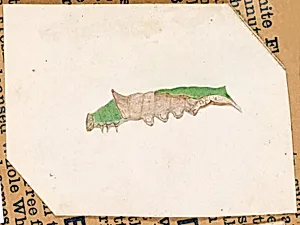
Oak Leaf Edge Caterpillar, study for book Concealing Coloration in the Animal Kingdom
Medium
Painting
Classification
Painting
Department
Smithsonian Collection
Museum
Smithsonian American Art Museum
Credit
Smithsonian American Art Museum, Gift of the heirs of Abbott Handerson Thayer
Accession Number
1950.2.22B
Rights
Public Domain
Tags
Art Historical Context
Visitors to the Smithsonian American Art are delighted by *Oak Leaf Edge Caterpillar*, a meticulous painting by Gerald H.ayer, created as a study for the book *Concealingoration in the Animal Kingdom This work captures the uncanny resemblance of a caterpillar to the jagged edge of an oak leaf showcasing nature's masterful camouflage. Donated by the heirs of Handerson Thayer—Gerald's father and a key collaborator—the piece bridges art and science in the museum's collection. Gerald H Thayer, working in the early 20th century, contributed to his father's influential 1909 treatise, which argued that animals' colors and patterns evolved primarily for concealment through countershading and disruptive coloration. This painting exemplifies that theory, rendering the insect with hyper-realistic detail to demonstrate how its body mimics foliage contours, blending seamlessly into its environment. At a time when evolutionary biology and natural history were hotly debated, the Thayers' visual studies provided compelling evidence, influencing fields from ornithology to military camouflage. As a painting in oil or gouache—typical for such precise natural history illustrations—this study highlights the Thayers' artistic precision rooted in American Realism. Its presence in the Smithsonian underscores the enduring fusion of aesthetic beauty and scientific insight, inviting us to look closer at the wonders of disguise in the animal world.