
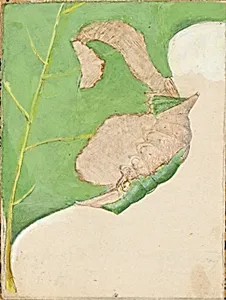
Oak Leaf Edge Caterpillar, study for book Concealing Coloration in the Animal Kingdom
Medium
Painting
Classification
Painting
Department
Smithsonian Collection
Museum
Smithsonian American Art Museum
Credit
Smithsonian American Art Museum, Gift of the heirs of Abbott Handerson Thayer
Accession Number
1950.2.22C
Rights
Public Domain
Tags
Art Historical Context
Behold the mesmerizing "Oak Leaf Edge Caterpillar," meticulous painting by Gerald H.ayer, created as a study for his father's seminal book *Concealingoration in the Animal Kingdom This undated work, now housed in the Smithsonian American Museum, captures the uncanny resemblance of a caterpillar to the jagged edge of an oak leaf perfect example of nature's camouflage artistry. Donated by the heirs of Abbott Handerson Thayer it bridges the worlds of fine art and scientific observation. , son of the pioneering Abbott Thayer, contributed to early 20th-century debates on animal coloration, challenging prevailing ideas by emphasizing how creatures blend seamlessly into their environments through "concealing coloration." This painting exemplifies that theory, showcasing the Thayers' belief in countershading and overall mimicry as survival mechanisms, predating modern evolutionary biology illustrations. Rendered in oil or similar medium, the study's hyper-realistic technique invites viewers to question what's real: insect or foliage? It highlights the era's fusion of natural history illustration and artistic precision, reminding us how art can illuminate science's wonders for curious eyes.