
Octagonal Tile
Unknown Artist
15th century or later
Medium
Stonepaste
Dimensions
D: 7 in. (17.8 cm)
Classification
Ceramics-Tiles
Department
Islamic Art
Museum
Metropolitan Museum of Art, New York, NY
Credit
Edward C. Moore Collection, Bequest of Edward C. Moore, 1891
Accession Number
91.1.1526
Rights
Public Domain
Tags
Art Historical Context
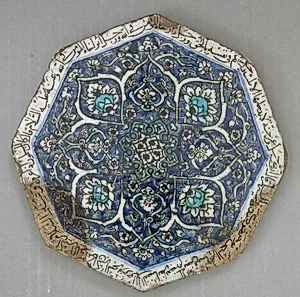
This octagonal tile presents a lively composition centered on a symmetrical floral medallion. Deep cobalt blue forms the background, while turquoise and white highlights define stylized lotus-like blossoms, curling vines, and geometric compartments that radiate outward. A narrow border of Arabic script runs along the outer edge, its flowing letters set against a lighter ground that shows the natural texture of the stonepaste material. Created by an unknown artist in the fifteenth century or later, the tile belongs to the long tradition of Islamic ceramic production. Stonepaste allowed potters to achieve fine detail and brilliant underglaze colors, making such works well suited for architectural decoration in mosques, palaces, and homes. The combination of floral motifs and calligraphy reflects the period’s emphasis on harmony between ornament and inscription. Now part of the Metropolitan Museum’s Edward C. Moore Collection, the piece offers visitors a tangible connection to the visual language of Islamic art, where pattern and word together create both beauty and meaning.