
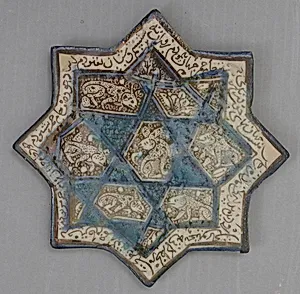
Star-Shaped Tile
Unknown Artist
14th century
Medium
Stonepaste; underglaze painted
Classification
Ceramics-Tiles
Department
Islamic Art
Museum
Metropolitan Museum of Art, New York, NY
Credit
Fletcher Fund, 1971
Accession Number
1971.235.1
Rights
Public Domain
Art Historical Context
Nestled in the Islamic Art collection at the Metropolitan Museum of Art, star-shaped tile from the 14th century the exquisite ceramic artistry of the medieval Islamic world. Crafted an unknown artist, its geometric form—evoking a radiant eight- or twelve-pointed star—was a hallmark of architectural decoration, often assembling into intricate mosaic panels adorning mosques, madrasas, and palaces across Persia, Syria, and beyond. from stonepaste (also known as fritware), composite material of quartz, clay, and glass frit, the tile mimics the translucency of coveted Chinese porcelain while allowing for vibrant underglaze painting. This technique involved painting designs directly onto the unfired body before applying a transparent glaze and firing, ensuring colors remained vivid and durable. Such innovations, peaking in the 13th-14th centuries under Ilkhanid and early Timurid patronage, elevated Islamic ceramics to rival other luxury arts. This modest yet masterful tile invites us to marvel at the anonymous craftsperson's skill, where geometry symbolized cosmic order and divine perfection. Acquired through the Fletcher Fund in 1971, it whispers of bustling workshops and opulent interiors, bridging us to a golden age of cultural splendor.