
Olympia (small plate)
1867
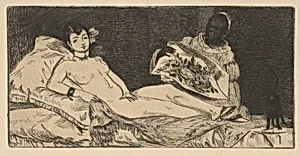
Medium
Etching on laid paper, sixth and final state
Dimensions
plate: 3 7/16 x 7in. (8.7 x 17.8cm) sheet: 4 7/8 x 8in. (12.4 x 20.3cm)
Classification
Prints
Department
Drawings and Prints
Museum
Metropolitan Museum of Art, New York, NY
Credit
Rogers Fund, 1921
Accession Number
21.76.12
Rights
Public Domain
Tags
Art Historical Context
Édouard Manet's *Olympia (small plate (1867) is a striking etching that captures the provocative essence of his infamous 1863 oil painting *Olympia*. In this intimate print, a nude woman reclines boldly, her direct gaze challenging the viewer, accompanied by a sleek black cat her feet—symbols that scandalized 19th-century Paris.et, a pivotal figure bridging Realism and Impressionism, drew from Old Master traditions like Titian's *Venus of Urbino* but infused it with modern urban life, portraying Olympia as a contemporary courtesan rather than an idealized goddess. Rendered in etching on laid paper, this sixth and final state showcases Manet's mastery of the medium. Etching involves incising lines into a metal plate with acid, allowing for precise, expressive lines that convey texture and form in this compact 3 7/16 x 7-inch plate. Printmaking enabled wider dissemination of his controversial image, amplifying its cultural impact beyond elite salons. Housed in the Metropolitan Museum of Art's Drawings and Prints department (Rogers Fund, 1921), this work exemplifies Manet's innovative spirit, pushing boundaries of nudity, gaze, and social commentary. It remains a cornerstone of modern art, inviting visitors to ponder the gaze's power and the evolving role of women in visual culture.
About the Artist
Edouard Manet · 1832–1883
Édouard Manet (1832-1883) was a French painter who played a pivotal role in the transition from Realism to Impressionism, often called the 'Father of Modern Art.' Born into a wealthy Parisian family, Manet defied his father's wishes for a legal career to pursue painting, studying under academic artist Thomas Couture. His revolutionary works 'Le Déjeuner sur l'herbe' and 'Olympia' (both 1863) scand...