
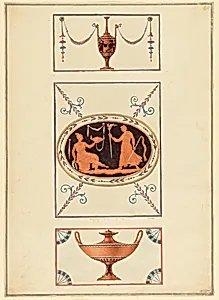
Ornament Design with Cameo and Urns
Classification
Drawing
Department
Smithsonian Collection
Museum
Smithsonian American Art Museum
Credit
Gift of Unknown Donor
Accession Number
1980-32-1478
Rights
Public Domain
About this artwork
Research in Progress
Art Historical Context
Michel Angelo Pergolesi’s *Ornament Design with Came and Urns* (1777) is a delicate drawing that captures the elegance of late 18th-century decorative arts. This Italian artist, active from around 1760 to 1801, specialized in intricate ornamental patterns inspired by classical antiquity. The composition likely features a cameo—a carved gemstone profile popular in neoclassical motifs—flanked by graceful urns, evoking timeless motifs of ancient Rome and Greece that were rediscovered through excavations at Pompeii and Herculane. Created during the height of the Neoclassical movement, this work reflects Europe’s growing fascination with archaeological revival. Pergolesi, who worked extensively in England, produced designs for furniture, ceramics, and architecture that bridged Rococo exuberance and the refined symmetry of the new style. As a drawing, it served as a blueprint for artisans, highlighting the precision and imagination required in ornamental drafting—a key technique for disseminating elegant patterns across workshops. Housed in the Smithsonian American Art Museum through a gift from an unknown donor, this piece offers a window into the global exchange of design ideas in the Georgian era. Though research continues, it stands as a testament to Pergolesi’s role in shaping tasteful interiors for the elite.