
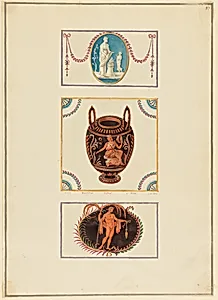
Ornament Design with Vase and Cameos
Classification
Drawing
Department
Smithsonian Collection
Museum
Smithsonian American Art Museum
Credit
Gift of Unknown Donor
Accession Number
1980-32-1467
Rights
Public Domain
About this artwork
Research in Progress
Art Historical Context
**Ornament Design with V and Cameos** Michel Angelo Pergolesi (Italian, active ca. 1760–1801), 1777* *Drawing; Smithsonian American Art Museum, Gift of Unknown Donor* into the refined world of 18th-century decorative arts with this delicate drawing by Michel Angelo Pergi, an Italian artist during the late Enlightenment. Created in 1777, *Ornament Design with V and Cameos* captures the elegance of neoclassical ornamentation featuring a vase and cameo motifs that evoke the grandeur of ancient Greco-Roman artifacts. These elements were hallmarks of the period's aesthetic revival, blending symmetry, classical motifs, and intricate detailing to inspire luxury goods like furniture, ceramics, and architecture. Pergolesi's work reflects the era's cultural shift toward neoclassicism, fueled by archaeological discoveries at sites like Pompeii and Herculaneum. Ornamental designs like this served as blueprints for artisans across Europe, promoting a taste for polished, antiquarian-inspired decoration amid the rise of grand estates and public buildings. As a drawing—its exact medium still under study—it highlights the meticulous preparatory techniques of the time, where pencil or ink sketches laid the foundation for reproducible patterns. Housed in the Smithsonian American Art Museum, this piece invites us to appreciate the unsung craft of design draftsmen. Though research continues, it stands as a testament to how everyday elegance was born from classical reverence, bridging art and everyday life in the 1770s. (198 words)