
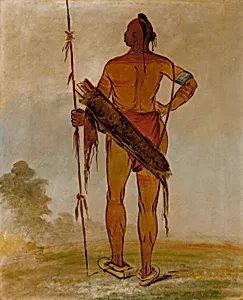
Pa-hú-sha, White Hair, the Younger, a Band Chief
1834
Medium
Painting
Classification
Painting
Department
Smithsonian Collection
Museum
Smithsonian American Art Museum
Credit
Smithsonian American Art Museum, Gift of Mrs. Joseph Harrison, Jr.
Accession Number
1985.66.43
Rights
Public Domain
Tags
About this artwork
“The White Hair is another distinguished leader of the Osages; and some have awarded to him the title of Head Chief; but in the jealous feelings of rivalry which have long agitated this tribe, and some times, even endangered its peace, I believe it has been generally agreed that his claims are third in the tribe; though he justly claims the title of a chief, and a very gallant and excellent man. The portrait of this man, I regret to say, I did not get.” George Catlin probably painted this image ...
Art Historical Context
George Catlin's *Pa-hú-sha, White Hair, the Younger, a Band Chief* (1834) captures the dignified presence of an Osage leader during a pivotal era of American expansion. Painted at Fort Gibson in present-day Oklahoma, this full-length portrait depicts Pa-hú-sha in traditional Indian dress, holding a spear, embodying the pride and complexity of Osage tribal life. Catlin, a pioneering 19th-century artist, dedicated his career to documenting Native American cultures through hundreds of portraits, driven by fears that westward settlement would erase them forever. His journey among the Osages in 1834 produced vivid ethnographic records like this one, now housed in the Smithsonian American Art Museum. In his *Letters and Notes* (1841), Catlin described White Hair as a "gallant and excellent man" whose claims to head chief were contested amid tribal rivalries, settling him as third in rank—a band chief nonetheless. Though Catlin lamented not securing a portrait in his notes, this oil painting stands as a testament to his skill in rendering authentic details of regalia and posture. Catlin's realistic style, blending portraiture with cultural observation, influenced American art's portrayal of Indigenous peoples, offering visitors a window into pre-removal Osage society and the artist's urgent mission to preserve vanishing traditions.
About the Artist
George Catlin · 1796–1872
George Catlin (1796–1872), born in Wilkes-Barre, Pennsylvania, to Putnam Catlin and Polly Sutton—who had been captured by Native Americans during the 1778 Battle of Wyoming—initially pursued a legal career. Trained at Litchfield Law School, he was admitted to the bar in 1819 but abandoned law after two years to study art in Philadelphia in 1823. Self-taught as a portraitist, Catlin quickly gained ...