
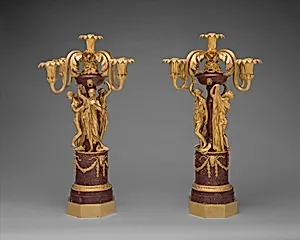
Pair of five-light candelabra
Medium
Bronze, fire-gilt; porphyry, iron (pin)
Dimensions
Overall (each): 27 × 15 15/16 in. (68.6 × 40.5 cm)
Classification
Metalwork-Gilt Bronze
Culture
Italian, Rome
Department
European Sculpture and Decorative Arts
Museum
Metropolitan Museum of Art, New York, NY
Credit
Wrightsman Fund, 1994
Accession Number
1994.14.1, .2
Rights
Public Domain
Tags
Art Historical Context
These exquisite five-light candelabra, created in Rome in 1774 by Luigi Valadier and Lorenzo Cardelli, showcase the refined luxury of 18th-century Italian decorative arts. Standing just over two feet tall, each piece combines fire-gilt bronze with rich porphyry, a stone prized since antiquity for its deep purple hue and imperial associations. The gilt bronze surface would have gleamed warmly by candlelight, transforming these functional objects into sculptural statements for aristocratic interiors. The design incorporates graceful female figures and nudes, reflecting the period’s renewed fascination with classical antiquity. In Rome, artists like Valadier drew inspiration from ancient ruins and excavated treasures, adapting mythological motifs to suit contemporary tastes. Such candelabra served not only to illuminate grand salons but also to display wealth and cultural sophistication. Today housed in the Metropolitan Museum of Art’s European Sculpture and Decorative Arts collection, these works remind us how 18th-century craftsmen elevated everyday objects into enduring art. Their harmonious blend of materials and classical imagery continues to captivate visitors with the elegance of the Enlightenment era.
About the Artist
Luigi Valadier|Lorenzo Cardelli · 1726–1785
**Luigi Valadier (1726–1785)** was a leading Italian goldsmith, silversmith, jeweler, and sculptor active in eighteenth-century Rome. Born in Rome on February 26, 1726, he was the son of Andrea Valadier, a French-born silversmith who had settled in the city in 1714 and established a successful workshop on via del Babuino. Luigi trained and began his career in his father’s workshop, assuming its di...