
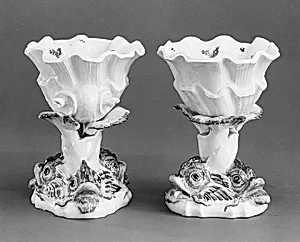
Pair of orange stands (part of a service)
Medium
Hard-paste porcelain
Dimensions
Height (each): 4 7/16 in. (11.3 cm)
Classification
Ceramics-Porcelain
Culture
German, Meissen
Department
European Sculpture and Decorative Arts
Museum
Metropolitan Museum of Art, New York, NY
Credit
Bequest of R. Thornton Wilson, in memory of his wife, Florence Ellsworth Wilson, 1977
Accession Number
1977.216.57, .58
Rights
Public Domain
Tags
Art Historical Context
This exquisite pair of orange stands, crafted by the renowned Meissen Manufactory modeling by Johann Friedrich Eber around 1738–41, the pinnacle of 18th-century European porcelain. Produced in hard-p porcelain—a technical marvel invented by Meissen in 1710 that mimicked the translucent quality of coveted Chinese wares—these petite stands (each just 4 7/16 inches tall) were designed as part of a luxurious dinner service. Their delicate forms, likely adorned with floral motifs, a practical yet opulent purpose: elevating oranges, a rare and status-symbolizing fruit in Baroque-era Europe, at lavish court banquets. Eberlein, a master sculptor at Meissen, contributed to the factory's Rococo flourishing under Saxon patronage, where porcelain became a canvas for intricate modeling and vibrant overglaze enameling. The stands' survival as a matched pair highlights the meticulous craftsmanship of the period, blending functionality with sculptural elegance. Displayed in the Metropolitan Museum of Art's European Sculpture and Decorative Arts department, they evoke the opulence of Dresden's royal table, where Meissen porcelain symbolized German innovation rivaling Asian imports. Fun fact: Meissen's crossed swords mark, introduced in 1720, ensured authenticity amid rampant fakes—proof of their prestige that these stands proudly bear.
About the Artist
Meissen Manufactory|Johann Friedrich Eberlein · 1710–present
The Meissen Manufactory, established on June 6, 1710, by Augustus the Strong, Elector of Saxony and King of Poland, marked the dawn of true hard-paste porcelain production in Europe. Nestled at Albrechtsburg Castle in Meissen near Dresden, the Royal Polish and Electoral Saxon Porcelain Manufactory arose from alchemical experiments begun in 1708 by physicist Ehrenfried Walther von Tschirnhaus and p...