
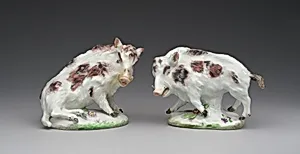
Pair of wild boars
ca. 1755
Medium
Soft-paste porcelain
Dimensions
Overall (.750): 4 1/2 × 5 1/2 in. (11.4 × 14 cm); Overall (.751): 4 × 6 in. (10.2 × 15.2 cm)
Classification
Ceramics-Porcelain
Culture
British, Derby
Department
European Sculpture and Decorative Arts
Museum
Metropolitan Museum of Art, New York, NY
Credit
Gift of Irwin Untermyer, 1964
Accession Number
64.101.750, .751
Rights
Public Domain
Tags
Art Historical Context
This delightful pair of wild boars, crafted by the Derby Porcelainufactory around 175, captures the lively spirit of 18th British decorative arts. Standing just 4 to 6 inches tall, soft-paste porcelain figures (.750 and .751) were designed as charming tabletop ornaments, ideal for the elegant interiors of Georgian homes The Derby factory, one of England's earliest porcelain producers founded in the 1750s, specialized in such whimsical animal models, drawing inspiration from nature to showcase their technical prowess. Soft-paste porcelain, a hallmark of early English ceramics, was a softer, more translucent alternative to true hard-paste from China or Saxony. Firing at lower temperatures allowed Derby artisans to achieve intricate details—like the boars' bristly hides, alert postures, and dynamic poses—while maintaining a creamy white body often enhanced with subtle glazes. These pieces reflect the era's fascination with naturalistic wildlife motifs, possibly evoking hunting traditions or exotic menageries popular among the aristocracy. Today, housed in the Metropolitan Museum of Art's European Sculpture and Decorative Arts Department as a 1964 gift from Irwin Untermyer, this pair highlights Derby's brief but brilliant golden age before merging with other factories. They invite visitors to appreciate the fusion of artistry and innovation that made British porcelain a global contender.
About the Artist
Derby Porcelain Manufactory · 1751–1785
The Derby Porcelain Manufactory stands as one of the foundational institutions of British ceramic art, producing some of the finest figures and tablewares made in England during the eighteenth and early nineteenth centuries. Its origins can be traced to the work of André Planché, a Huguenot immigrant from Saxony who settled in Derby around 1745 and began producing soft-paste porcelain figures and ...