
Panel
Unknown Artist
early 9th century
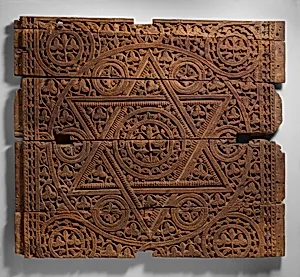
Medium
Wood (teak); carved
Dimensions
H. 29 1/2 in. (74.9 cm) W. 33 1/2 in. (85.1 cm) D. 1 in. (2.5 cm) Wt. 65 lbs. (29.5 kg)
Classification
Wood
Department
Islamic Art
Museum
Metropolitan Museum of Art, New York, NY
Credit
Rogers Fund, 1933
Accession Number
33.41.1a–e
Rights
Public Domain
Art Historical Context
This carved teak panel, created in the early 9th century, offers a rare glimpse into the refined woodworking traditions of the early Islamic world. Measuring nearly three feet across and weighing 65 pounds, the substantial piece highlights the skill of anonymous artisans who transformed durable tropical hardwood into functional yet decorative elements, likely for architectural use such as doors, screens, or furnishings. Teak’s natural resistance to decay made it a prized material, often sourced through extensive trade networks that connected the Islamic lands with regions to the east. Housed in the Metropolitan Museum of Art’s Department of Islamic Art, the panel reflects a period of artistic flourishing under the Abbasid caliphate, when intricate carving techniques flourished alongside developments in ceramics, textiles, and metalwork. The smooth, polished surface and precise chisel work demonstrate sophisticated control of form and depth, qualities that allowed wood to convey both structural strength and aesthetic elegance. Acquired by the museum in 1933 through the Rogers Fund, this object continues to invite visitors to appreciate the enduring legacy of early Islamic craftsmanship. Its presence in the collection underscores the global reach of Islamic art and the timeless appeal of carved wood as a medium for cultural expression.