
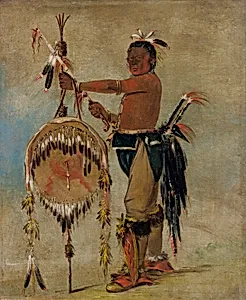
Pash-ee-pa-hó, Little Stabbing Chief, a Venerable Sauk Chief
1835
Medium
Painting
Classification
Painting
Department
Smithsonian Collection
Museum
Smithsonian American Art Museum
Credit
Smithsonian American Art Museum, Gift of Mrs. Joseph Harrison, Jr.
Accession Number
1985.66.11
Rights
Public Domain
Tags
About this artwork
“Pash-ee-pa-ho (the little stabbing chief), a very old man, holding his shield, staff and pipe in his hands; has long been the head civil chief of this tribe; but, as is generally the case in very old age, he has resigned the office to those who are younger and better qualified to do the duties of it.” (Catlin, Letters and Notes, vol. 2, no. 56, 1841; reprint 1973)
Art Historical Context
In 1835, George Catlin captured dignified likeness of Pash-ee-pa-hó, known as the Little Stabbing Chief, venerable leader of the Sauk tribepart of the Sauk Fox confederacy). This full-length oil portrait shows the elderly chief in traditional dress, clutching his shield, staff, pipe—symbols of his authority and warrior past. Catlin, a pioneering American artist, painted hundreds of such portraits during his travels among Indigenous peoples of the Great Plains and Midwest in the 1830s, aiming to document their cultures before rapid white settlement altered them forever. As Catlin noted in his *Letters and Notes* (1841), Pash-ee-pa-hó had long served as the tribe's head civil chief but, in advanced age, yielded his duties to younger men. Rendered with Catlin's characteristic realism, the painting highlights the chief's weathered features and poised stance, evoking respect for his lifelong service amid turbulent times, including the recent Black Hawk War (1832). The pipe in his hand underscores Sauk customs of council and ceremony. Today, housed in the Smithsonian American Art Museum, this work stands as a poignant record of Sauk heritage, blending portraiture with ethnography to preserve a vanishing world for future generations.
About the Artist
George Catlin · 1796–1872
George Catlin (1796–1872), born in Wilkes-Barre, Pennsylvania, to Putnam Catlin and Polly Sutton—who had been captured by Native Americans during the 1778 Battle of Wyoming—initially pursued a legal career. Trained at Litchfield Law School, he was admitted to the bar in 1819 but abandoned law after two years to study art in Philadelphia in 1823. Self-taught as a portraitist, Catlin quickly gained ...