
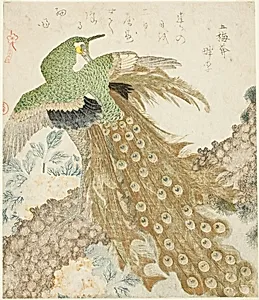
Peacock, Pine Tree, and Peonies, from the series "A Set of Three Petals (San hira no uchi)"
1810s
Medium
Color woodblock print; shikishiban, surimono
Dimensions
20.1 × 17.3 cm (7 15/16 × 6 13/16 in.)
Classification
woodblock print
Department
Arts of Asia
Museum
Art Institute of Chicago
Accession Number
81376
Rights
Public Domain
Art Historical Context
Kubo Shunman's *Peacock, Pine Tree and Peonies*, from series *A Set of Three Petals (San h no uchi)*, is a exquisite example of early 19th-century Japanese surimono—a luxurious, privately commissioned woodblock print produced in the 1810s during the Edo period. Measuring just 20.1 × 17.3 cm in the intimate shikishiban (square) format, these prints were often created for poetry clubs or New Year's greetings, featuring high-quality pigments, subtle embossing, and metallic accents for a tactile, jewel-like effect. The composition vibrantly captures a peacock perched amid a pine tree and blooming peonies, symbols rich in Japanese culture: the pine evokes longevity and resilience, peonies represent prosperity and bravery, and the peacock adds a splash of exotic splendor and protection against evil. Shunman, a versatile ukiyo-e artist and poet, masterfully blends these motifs in delicate colors and flowing lines, showcasing his skill in surimono's refined techniques that elevated private art beyond commercial woodblocks. Part of a thematic trio likely centered on floral elegance, this print from the Art Institute of Chicago's Arts of Asia collection highlights surimono's role in fostering literary and artistic communities, offering a window into Edo Japan's sophisticated connoisseurship.
About the Artist
Kubo Shunman · 1757–1820
Japanese, 1757–1820