
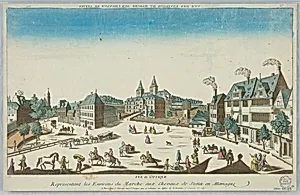
Peep-show, Vue d'Optique Representant les Environs du Marché aux Chevaux de Stetin en Allemagne
ca. 1750
Classification
Department
Smithsonian Collection
Museum
Smithsonian American Art Museum
Credit
Gift of Mrs. Edward R. Wharton
Accession Number
1901-30-23
Rights
Public Domain
About this artwork
Research in Progress
Art Historical Context
Step into the lively world of 18th-century Europe with *Peep-show, Vue d'Optique Representant les Environs du Marché aux Chevaux de Stetin en Allemagne*, a captivating print from around 1750. This artwork depicts the bustling surroundings of the horse market in Stettin (now Szczecin, Poland), then a vibrant trading hub in Prussian Pomerania. As a *vue d'optique*—a specialized print designed for viewing through an optical peep-show device—the image features exaggerated perspective lines that converge dramatically, creating an immersive, three-dimensional illusion when peered at through curved lenses. These optical prints flourished in mid-18th-century France and the Netherlands, blending art with popular entertainment during the Enlightenment's fascination with science, travel, and spectacle. Produced for the curious middle class, they brought distant scenes like lively markets alive in parlors, evoking the sounds of neighing horses and haggling traders. Though the artist remains unknown, the technique highlights innovative printmaking that merged engraving with optics, making geography feel tangible. Today, housed in the Smithsonian American Art Museum as a gift from Mrs. Edward R. Wharton, this piece invites us to ponder how everyday commerce in far-off Stettin captured imaginations centuries ago—research continues to uncover more about its creation.
About the Artist
Unknown
The artist designated as "Unknown" in our virtual museum's collection exemplifies a poignant chapter in art history: creators whose identities have faded into obscurity despite the enduring power of their work. With only one known artwork attributed to them in our holdings, this figure represents countless anonymous hands that shaped visual culture across centuries. Museums worldwide, including th...