
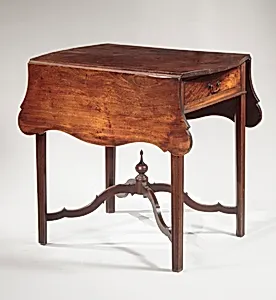
Pembroke Table
c. 1790
Medium
Mahogany, white pine, brass, and iron
Dimensions
71.8 × 76.2 × 55.2 cm (28 1/4 × 30 × 22 1/8 in.)
Classification
table
Department
Arts of the Americas
Museum
Art Institute of Chicago
Accession Number
212764
Rights
Public Domain
About this artwork
Named for the woman who first commissioned a table of this type in England around the mid-18th century, the Pembroke table was a popular form in American furniture from the late 18th century through 1840. While such tables were primarily used for breakfast dining, as a small, practical table, it could have been utilized for other activities as well, including gaming, reading, and writing. Four fixed legs, two drop leaves, and swing rails (to support the hinged leaves when open) generally charact...
Art Historical Context
This elegant Pembroke table, crafted around 1790, exemplifies the refined furniture of early America during the Federal period. Made primarily from rich mahogany—a premium imported wood symbolizing prosperity and status—with secondary white pine, brass hardware, and iron supports, it measures a compact 71.8 × 76.2 × 55.2 cm. Its hallmark design features two hinged drop-leaves that fold down against a central pedestal base, allowing it to serve as a space-saving side table or expand into a convenient surface for tea, dining, or work. Such versatility made Pembroke tables immensely popular in growing urban households of the post-Revolutionary era. Housed in the Art Institute of Chicago's Arts of the Americas department, this anonymous masterpiece reflects the neoclassical influences of the time, inspired by British and European designs adapted by skilled American cabinetmakers. The use of brass for gleaming drawer pulls and hinges, paired with sturdy iron for durability, highlights expert joinery techniques that ensured both beauty and functionality. In an age of emerging middle-class refinement, pieces like this underscored cultural aspirations, blending practicality with understated luxury for everyday domestic life. Visitors will appreciate its timeless appeal as a window into 18th-century American ingenuity.