
Peter Paul Rubens
1630/45
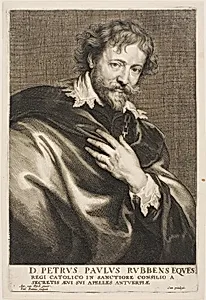
Medium
Etching and engraving in black on cream laid paper
Dimensions
Plate: 23.4 × 15.6 cm (9 1/4 × 6 3/16 in.); Sheet: 24.4 × 16.6 cm (9 5/8 × 6 9/16 in.)
Classification
Department
Prints and Drawings
Museum
Art Institute of Chicago
Accession Number
40438
Rights
Public Domain
About this artwork
Paul Pontius was trained as a painter prior to studying engraving. By the age of 24, he was a master in the Antwerp guild and was the primary artist responsible for making engravings after the work of Peter Paul Rubens. During his life, Rubens closely supervised the printmakers who reproduced his work, encouraging them to imitate his style as closely as possible. Pontius actually lived in Rubens’s house until a year after the painter’s death, at which time he went on to make engravings, such as ...
Art Historical Context
This etching and engraving by Flemish printmaker Paul Pontius presents a striking portrait of the celebrated Baroque painter Peter Paul Rubens. Created between 1630 and 1645, the work captures Rubens during the height of his international fame, when his dynamic compositions and rich color palette defined Northern European art. Pontius, who frequently collaborated with Rubens’ studio, translated the painter’s lively presence into the precise lines of print media, allowing viewers to connect with the master’s charismatic personality. The medium itself highlights the artistic innovations of the period. Combining etching’s fluid lines with engraving’s crisp detail, Pontius achieved subtle tonal gradations on cream laid paper that evoke the luminosity and texture of Rubens’ oil paintings. Such reproductive prints played a vital cultural role in the 17th century, circulating images of celebrated artists across Europe and shaping public appreciation of Baroque ideals. Housed in the Art Institute of Chicago’s Prints and Drawings department, this intimate work (roughly the size of a sheet of notebook paper) offers a window into how printmaking helped preserve and popularize the legacy of one of art history’s most influential figures.