
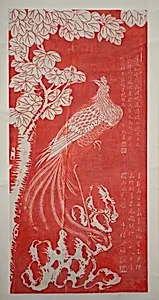
Phoenix
printed 1922
Medium
Hanging scroll of polychrome woodblock print; ink and color on paper
Dimensions
Image: 44 1/2 x 21 3/4in. (113 x 55.2cm) Overall with mounting: 82 x 26 in. (208.3 x 66 cm) Overall with knobs: 82 x 29 7/8 in. (208.3 x 75.9 cm)
Classification
Prints
Culture & Period
China · Modern period
Department
Asian Art
Museum
Metropolitan Museum of Art, New York, NY
Credit
Rogers Fund, 1924
Accession Number
CP270
Rights
Public Domain
Art Historical Context
This striking hanging scroll titled *Phoenix* exemplifies the enduring vitality of Chinese woodblock printing in the modern era. Created in 1922 through a collaboration between artists Kuang Xü and Lü Ji, the work employs the demanding polychrome technique, in which multiple carved blocks apply layered inks and colors to paper. The resulting image achieves the luminous depth and precision usually associated with hand-painted scrolls while allowing wider circulation of the design. Its impressive scale—over six feet when mounted—transforms the traditionally intimate print medium into a commanding vertical composition suited for display in grand interiors. The scroll format itself carries centuries of cultural resonance, originally developed to present calligraphy and painting in a portable yet elegant manner. By adopting this format for a printed image, the artists bridged classical aesthetics with early-twentieth-century reproduction methods, reflecting China’s ongoing dialogue between tradition and modernity during the Republican period. Acquired by the Metropolitan Museum in 1924, the work stands as a testament to the technical sophistication and artistic ambition of Chinese printmakers at a pivotal moment in the nation’s cultural history.
About the Artist
Kuang Xü|Lü Ji (Chinese|Chinese) · 1874 |1736 –1909 |1795
Chinese, 1874–1909|Chinese, Qing dynasty, Qianlong period (1736–1795)